

by Jemeana Smothers-Roberson, Associate Publisher and Managing Editor, Speakin’ Out News
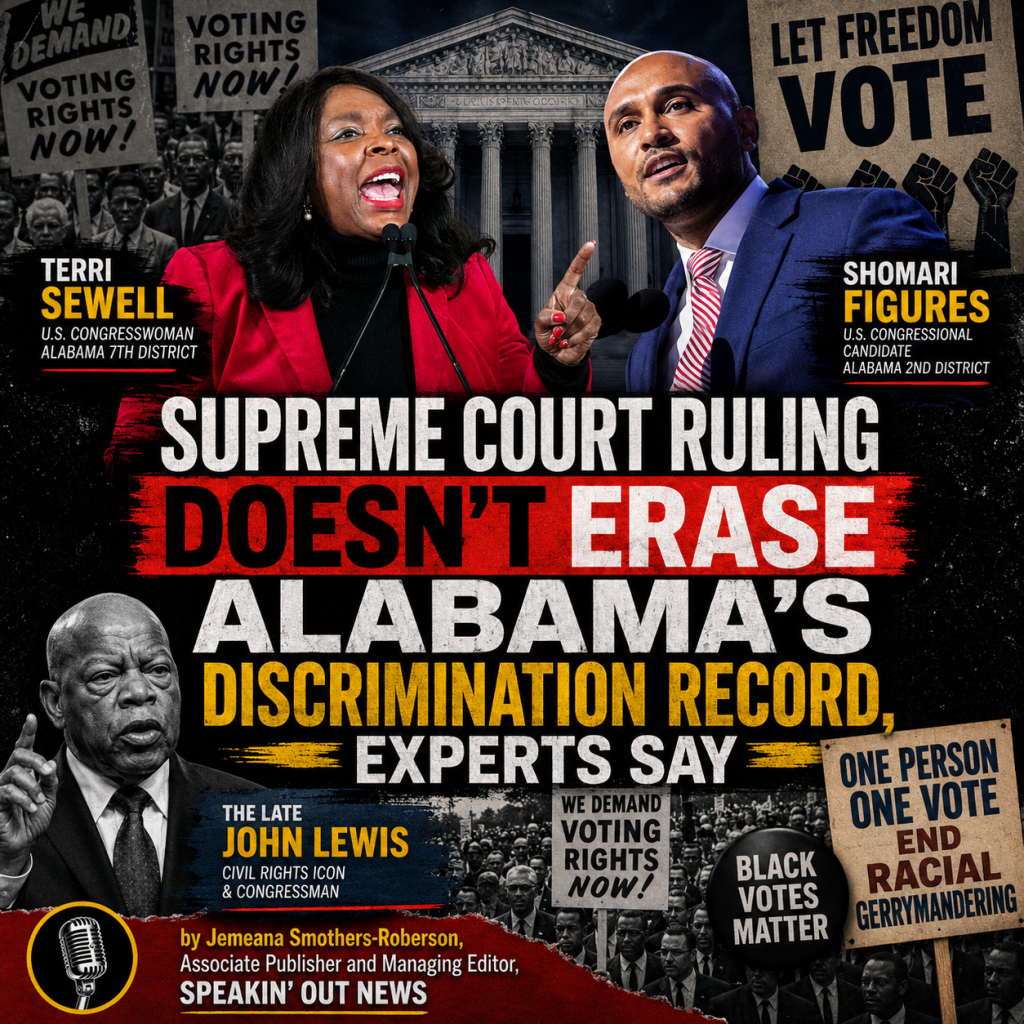
Alabama legislators face renewed legal challenges – Rep. Shomari Figures (D-Mobile) won Alabama’s redrawn District 2 in November 2024 with 54.5% of the vote, becoming the state’s second Black congressional representative. His district, which includes Mobile, Montgomery, and Black Belt communities, faces potential elimination under new Republican redistricting efforts.Rep. Terri Sewell (D-Birmingham) has represented Alabama’s 7th Congressional District since 2011. Federal courts found that Alabama’s 2021 maps packed excess Black voters into her district while diluting their influence in neighboring areas including the Black Belt region. (photo credit: SPEAKIN’ OUT NEWS)
MONTGOMERY, AL — While the U.S. Supreme Court’s May 11 decision to vacate Alabama’s 2023 redistricting ruling represents a procedural victory for state Republicans, legal experts and civil rights advocates say the path forward remains complicated by extensive factual findings of intentional discrimination against Black voters.
A three-judge panel, including two Trump appointees, concluded after an 11-day trial that Alabama’s 2023 maps represented an intentional effort to dilute Black voting strength. The judges wrote they could not understand the plan as anything other than designed to crack Black voters across districts and perpetuate discriminatory effects, findings established through 51 witnesses, nearly 800 exhibits, and extensive written submissions.
These determinations remain part of the case record despite the Supreme Court sending the matter back for reconsideration under Louisiana v. Callais standards. Justice Sonia Sotomayor noted in dissent that the district court’s finding of intentional Fourteenth Amendment violations is independent of and unaffected by legal issues in Callais, calling racially discriminatory vote dilution an inextricable, permanent feature of this case.
Federal courts initially struck down Alabama’s 2021 maps for packing Black voters into Congressional District 7, represented by Democrat Terri Sewell, while diluting their influence in Black Belt communities and elsewhere. Court-ordered maps created District 2 with 48.7% Black voting-age population compared to 45% white. Using Alabama’s 2023 maps would reduce District 2’s BVAP to under 40% and District 7’s BVAP to 50.6%.
Democrat Shomari Figures won District 2 in November 2024 with 54.5% of the vote, marking the first time Alabama sent two Black members to Congress simultaneously. Figures called Monday’s decision an incredibly unfortunate action where conservative justices substituted themselves as defense lawyers for Alabama.
Rep. Terri Sewell stated Alabama lawmakers intentionally discriminated against Black voters in drawing the 2023 map, adding that the federal district and Supreme courts both confirmed this finding. She declared: The Foot Soldiers of the Civil Rights Movement fought, bled, and died to overturn Jim Crow in the South and secure Black representation in government. Black voters make up nearly one-third of Alabama’s electorate, and we deserve no less than two seats where we can select a candidate of our choice.
Attorney General Steve Marshall countered that federal courts had punished the state for drawing its own maps, but the Supreme Court vindicated the state’s position. Dev Wakeley of Alabama Arise stated the Supreme Court has upended election jurisprudence in a way that severely and systematically disadvantages Black voters.
Nicholas Stephanopoulos, election law professor at Harvard Law School, has noted that nearly 70 of the 435 congressional districts nationwide are protected by Section 2 of the Voting Rights Act, and that the Callais decision’s practical effect is to make it far harder for minority communities to challenge redistricting maps that dilute their political voice.
Significantly, Republican-appointed federal judges ruled against Alabama’s maps, underscoring that determinations of vote dilution affecting Black Belt communities were based on evidence rather than partisan preference. This bipartisan judicial consensus creates a substantial evidentiary foundation that remains intact despite procedural changes from Callais.
As Alabama legislators draft new congressional maps, the outcome depends on whether proposed districts can withstand legal scrutiny under both the established factual record of intentional discrimination and modified Section 2 framework. Legal observers expect renewed litigation regardless of what maps emerge. Primary elections scheduled for May 19 remain in flux.
Sources:
1. U.S. Supreme Court Order, Allen v. Caster, May 11, 2026
2. Justice Sonia Sotomayor Dissent, Allen v. Caster, May 11, 2026
3. Three-Judge Panel Ruling, Allen v. Milligan, Northern District of Alabama, May 8, 2025
4. Louisiana v. Callais, U.S. Supreme Court Decision, April 29, 2026
5. Rep. Terri Sewell statements, Alabama Reflector, May 11, 2026
6. Rep. Shomari Figures statement, Alabama Reflector, May 11, 2026
7. Attorney General Steve Marshall statement, Alabama Reflector, May 11, 2026
8. Dev Wakeley, Alabama Arise, Alabama Reflector, May 11, 2026
9. Nicholas Stephanopoulos, Harvard Law School, PBS News, April 2026
10. SCOTUSblog analysis, May 11, 2026
11. NPR News coverage, May 9, 2025
12. Democracy Docket analysis, May 9, 2025
13. Ballotpedia redistricting data, May 2026
14. Election results data, Alabama Reflector and NBC News, November 2024


