


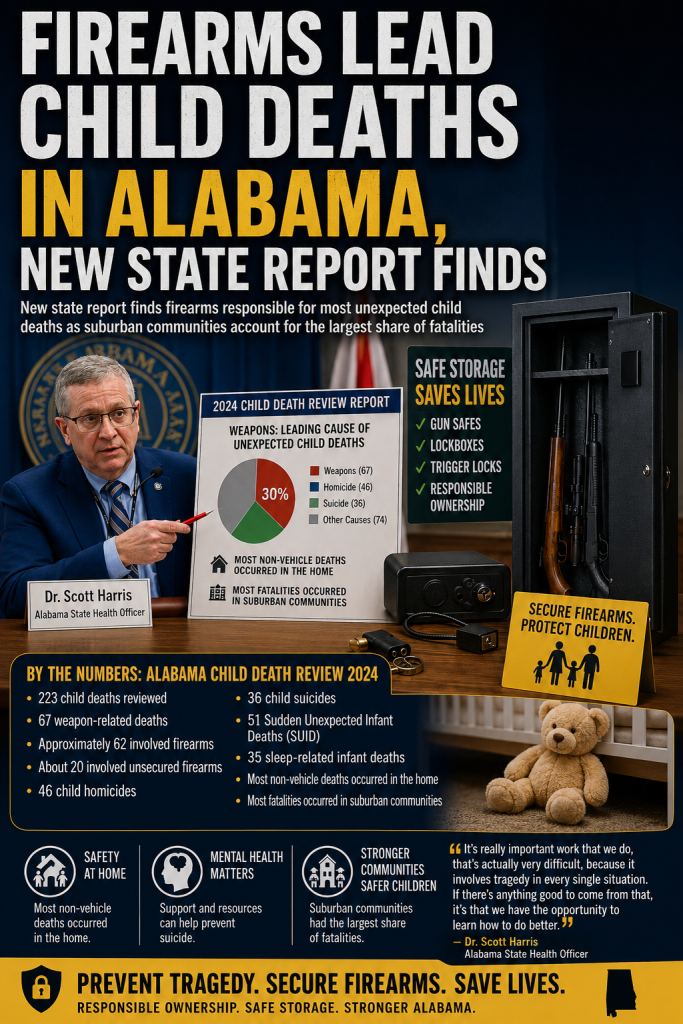
MONTGOMERY — Firearms were the leading cause of non-medical, unexpected, or unexplained deaths among Alabama children in 2024, according to a newly released report that is renewing calls for stronger safety measures, public education, and responsible firearm storage.
The findings were presented by Dr. Scott Harris, Alabama’s State Health Officer, during a meeting of the State Committee on Public Health. The report, compiled by the State Child Death Review Team, examined 223 child deaths involving individuals under age 18 and identified weapons as the leading cause of those fatalities.
Weapon-related deaths accounted for roughly 30 percent of all cases reviewed by the committee. Of the 67 weapon-related deaths, approximately 62 involved firearms, making guns the leading contributor to unexpected child fatalities reviewed by the state team. The report also found that about one-third of firearm-related deaths involved guns that were not safely stored.
That means approximately 20 children died in incidents involving unsecured firearms. Health officials say many of those tragedies may have been preventable through the use of gun safes, lockboxes, trigger locks, and secure firearm storage practices.
The findings mirror a growing national concern. Firearms have become the leading cause of death for children and teenagers in the United States, surpassing motor vehicle accidents in recent years.
The report found that most non-vehicle-related child deaths occurred in the child’s home, highlighting the critical role parents and caregivers play in preventing tragedies. One of the report’s most notable findings was that the largest share of deaths occurred in suburban communities rather than urban areas, challenging assumptions about where children face the greatest risks.
Alabama currently does not have a law requiring firearm owners to securely store weapons when children may have access to them. With approximately 20 child firearm deaths in 2024 linked to unsecured guns, advocates argue that safe storage remains one of the most immediate and effective ways to prevent future tragedies.
Former State Rep. Allen Treadaway Simpson supported tax incentives for gun safes rather than penalties for gun owners, arguing that encouraging safe storage may be more effective than punishment.
“The only response you have is some form of punishment, whether that be a civil fine or some form of criminal charge, and that’s just not something that I was willing to go for,” Simpson said. “You either give them the incentive to buy the safe by cutting taxes, or you give them a punishment of some sort.”
The cost of securing firearms can be a challenge for some families. Gun safes range from about $80 for a basic handgun lockbox to more than $2,000 for larger home safes.
State Rep. Barbara Drummond, D-Mobile, has advocated for expanding access to gun storage boxes and safety devices. Supporters say providing affordable or free lockboxes could help families safely secure firearms while promoting responsible gun ownership.
Rep. Phillip Ensler, D-Montgomery, said lawmakers should continue pursuing practical safety measures even if they are not perfect solutions.
“Just because it’s not perfect doesn’t mean that we should not have it,” Ensler said. “There are reasonable ways that law enforcement could enforce it. I realize there may be some challenges, but I don’t think that perfection should be the enemy of good.”
Ensler also pointed to conflict-resolution education as another tool for reducing youth violence. Earlier this year, Gov. Kay Ivey signed legislation requiring conflict-resolution instruction in Alabama schools.
The report also examined other causes of child deaths. In 2024, there were 46 homicides and 36 suicides involving children under 18. While firearms remained a major concern, those figures represented improvement from 2023, when the state recorded 59 homicides and 45 suicides among children.
Infant deaths remain another area of concern. The review identified 51 Sudden Unexpected Infant Deaths (SUID) and 35 sleep-related deaths, many involving unsafe sleeping environments. Health experts continue to recommend that infants sleep alone, on their backs, in a crib free of pillows, blankets, and stuffed animals.
Despite the difficult subject matter, Harris said the review process provides an opportunity to identify preventable risks and save lives.
“It’s really important work that we do, that’s actually very difficult, because it involves tragedy in every single situation,” Harris said. “If there’s anything good to come from that, it’s that we have the opportunity to learn how to do better.”
Health officials say the report serves as a reminder that preventing child deaths requires a combination of responsible firearm ownership, public education, mental health support, conflict-resolution programs, safe-sleep practices, and community awareness.
BY THE NUMBERS: ALABAMA CHILD DEATH REVIEW 2024
• 223 child deaths reviewed
• 67 weapon-related deaths
• Approximately 62 involved firearms
• About 20 involved unsecured firearms
• 46 child homicides
• 36 child suicides
•51 Sudden Unexpected Infant Deaths (SUID)
• 35 sleep-related infant deaths
• Most non-vehicle deaths occurred in the home
• Most fatalities occurred in suburban communities


