

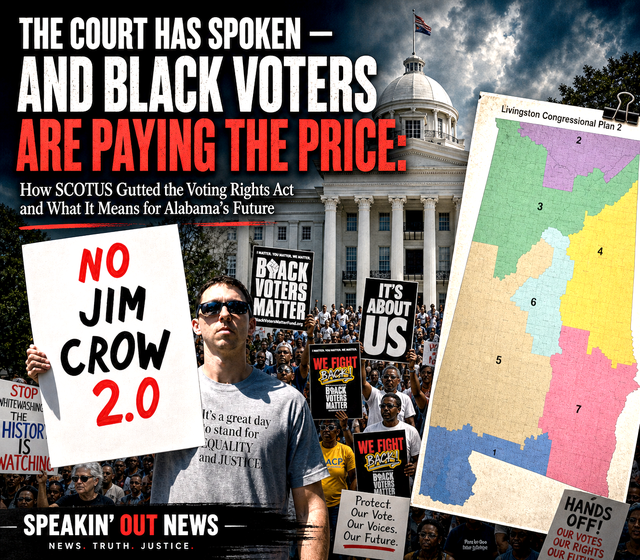
On April 29, 2026, the United States Supreme Court handed down one of the most consequential civil rights rulings in a generation — and the reverberations are shaking Alabama to its political foundations.
In a 6-3 decision split along ideological lines, the Court ruled in Louisiana v. Callais that race-conscious congressional redistricting under Section 2 of the Voting Rights Act of 1965 is unconstitutional. The decision struck down Louisiana’s second majority-Black congressional district and effectively rendered Section 2 of the VRA — the last remaining major enforcement tool of the landmark 1965 civil rights law — what Justice Elena Kagan called in her dissent ‘all but a dead letter.’
The ruling did not formally strike down the text of the VRA. But its practical effect, legal scholars and civil rights advocates say, is the same. For more than six decades, Section 2 provided Black voters, Hispanic communities, Native Americans, and other minority groups a federal mechanism to challenge voting maps that diluted their political power — even when the discrimination was disguised as partisan preference. Louisiana v. Callais has now slammed that door.
Writing for the majority, Justice Samuel Alito held that ‘the Constitution almost never permits the Federal Government or a State to discriminate on the basis of race’ and concluded that creating majority-minority districts — even to comply with court orders under the VRA — constitutes an unconstitutional racial gerrymander. In a separate concurrence, Justice Clarence Thomas went further, arguing that Section 2 ‘should never have been interpreted to effectively give racial groups an entitlement to roughly proportional representation.’
The dissent, written by Justice Kagan and joined by Justices Sotomayor and Jackson, was blunt. By ‘prioritizing formal colorblindness over substantive equality,’ Kagan wrote, the majority has ‘recast the Reconstruction Amendments from tools of inclusion into constraints on remediation.’ The dissenters warned that ignoring the real-world operation of racial discrimination does not produce neutrality — it entrenches inequality.
ALABAMA MOVES FAST — AND THE STAKES ARE HIGH
Alabama has wasted no time seizing on the ruling. Within 24 hours of the decision, Alabama Attorney General Steve Marshall and Secretary of State Wes Allen filed emergency motions asking the Supreme Court to lift the injunctions that have kept a court-ordered redistricting map in place — the very map that in 2023 created Alabama’s second majority-Black congressional district and produced the election of a second Black U.S. House representative.
Governor Kay Ivey called the Alabama Legislature back to Montgomery for a special session, announcing she wants the state prepared to hold special primary elections if the Supreme Court acts quickly enough to allow Alabama’s Republican-drawn 2023 map — which excluded the second Black district — to be restored before the November midterms. Republican legislative leaders made their intentions clear, with leadership saying the special session would ‘give our state a fighting chance to send seven Republican members to Congress.’ The delegation currently includes two Democrats.
Alabama AG Marshall celebrated the ruling as a historic victory. ‘The Supreme Court has spoken,’ he said. ‘States cannot be forced to gerrymander by race.’ Marshall told CNN that ‘the Alabama in 2026 is not the Alabama of the early 1960s.’ Civil rights leaders strongly disagree — pointing to Alabama’s history of sustained efforts to minimize Black political power and arguing that the ruling now removes the principal legal tool communities have used to fight back.
The Campaign Legal Center called the decision ‘one of the most consequential setbacks for our multiracial democracy in a generation.’ The NAACP Legal Defense Fund warned that ‘fair districts across the nation will likely vanish as legislatures aim to gut representation for voters of color.’ U.S. Senator Raphael Warnock of Georgia, speaking from the pulpit of Ebenezer Baptist Church, described the redistricting scramble as a rollback of the Civil Rights Movement itself. ‘That isn’t a new method,’ he said. ‘That’s an old method. That’s a Jim Crow method.’
WHAT’S AT STAKE FOR BLACK COMMUNITIES IN HUNTSVILLE, MONTGOMERY, AND MOBILE
For Black residents across Alabama — in Huntsville’s historically Black neighborhoods, in Montgomery’s civil rights corridors, and in Mobile’s underserved communities — the implications extend far beyond electoral politics. Congressional districts determine which communities have the federal representation to secure appropriations for workforce development, HBCU funding, small business contracting, infrastructure investment, and community development resources.
Analysts note that the ruling also affects Section 2 protections for Hispanic, Native American, and Asian American communities nationwide. The decision, Alabama Reporter analysis found, exposes ‘a deeper tension within modern voting-rights law’ — with the VRA requiring states to consider race to prevent vote dilution while the Equal Protection Clause increasingly limiting how much race can shape government decisions.
The Alabama primary is currently scheduled for May 19. Whether the Supreme Court acts in time to shift the maps before that election remains uncertain. What is certain is this: the fight for fair representation in Alabama — a fight that began before the 1965 march across the Edmund Pettus Bridge — is far from over. And communities across this state will need to be louder, more organized, and more engaged than ever to defend the ground that generations before them paid for in blood.


