

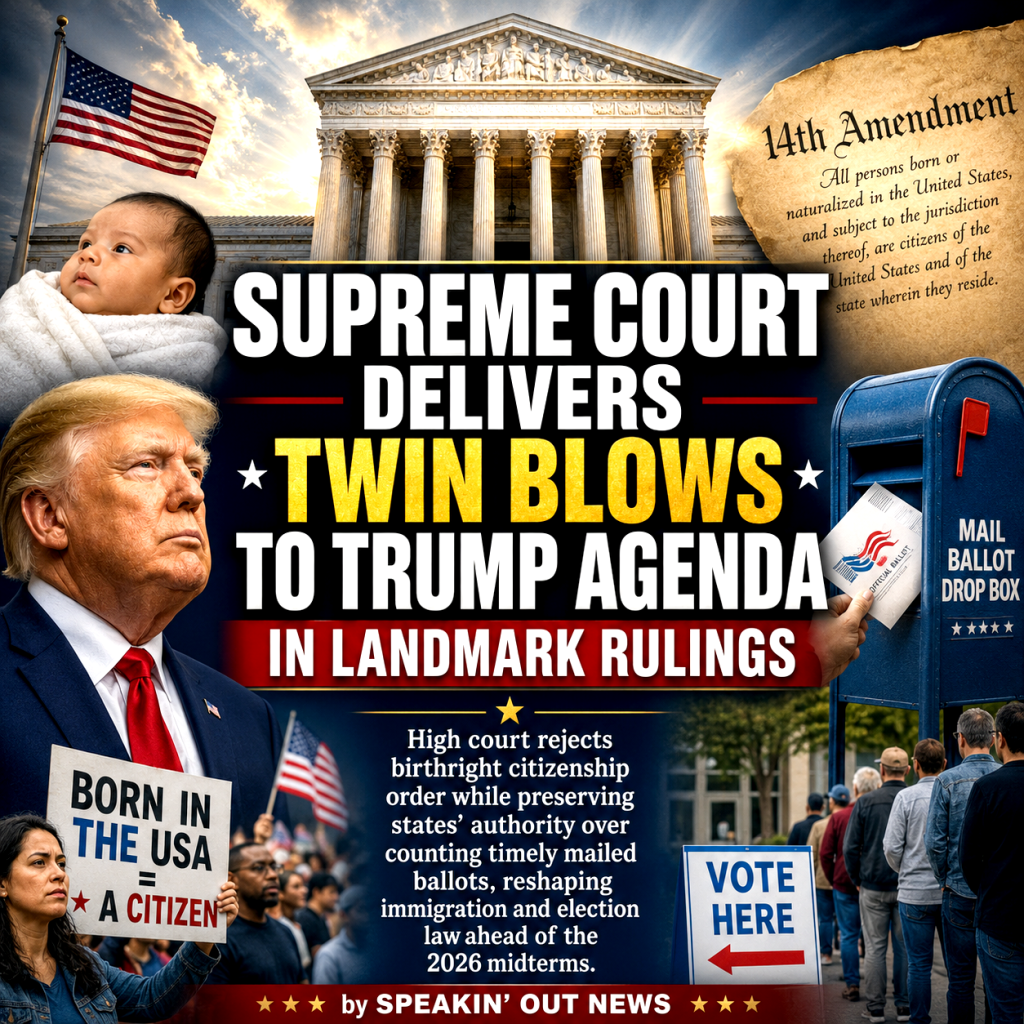
WASHINGTON — In one of the most consequential weeks of the Court’s 2026 term, the U.S. Supreme Court delivered two major setbacks to President Donald Trump’s policy agenda, rejecting his administration’s effort to end birthright citizenship while also refusing to block states from counting certain mail ballots received after Election Day.
Taken together, the rulings reaffirm long-standing constitutional protections, preserve state authority over election administration, and underscore the Court’s willingness to place limits on presidential power even as it continues to shape American law on some of the nation’s most divisive issues. The decisions arrive as immigration and election integrity remain central themes of Trump’s second term and as political parties prepare for the 2026 midterm elections.
The Court’s most significant decision came Tuesday when a majority of justices struck down Trump’s executive order restricting birthright citizenship, concluding that the policy conflicts with the Citizenship Clause of the 14th Amendment.
The executive order, signed on Trump’s first day back in office, sought to deny automatic U.S. citizenship to children born in the United States unless at least one parent was a U.S. citizen or lawful permanent resident. The policy immediately sparked lawsuits from states, civil rights organizations, and expectant mothers, preventing it from ever taking effect.
Writing for the majority, Chief Justice John Roberts rejected the administration’s interpretation of the Constitution.
“The trouble is that there is scant evidence for this dramatically revisionist view,” Roberts wrote.
Roberts was joined by Justices Sonia Sotomayor, Elena Kagan, Ketanji Brown Jackson, and Amy Coney Barrett. Justice Brett Kavanaugh agreed the executive order could not take effect based on federal law, while Justices Clarence Thomas, Samuel Alito, and Neil Gorsuch dissented.
The ruling reinforces one of the nation’s oldest constitutional principles. Ratified in 1868 following the Civil War, the 14th Amendment was adopted to guarantee citizenship to formerly enslaved Americans and ensure that no state could deny citizenship to people born in the United States. Thirty years later, the Supreme Court’s landmark 1898 decision in United States v. Wong Kim Ark affirmed that nearly everyone born on American soil is a U.S. citizen, regardless of their parents’ nationality or immigration status, with only narrow exceptions such as children of foreign diplomats or hostile occupying forces.
Civil rights advocates celebrated the ruling as a powerful reaffirmation of constitutional protections.
“The court’s decision reaffirms a fundamental American promise — if you are born here, you are a citizen,” ACLU National Legal Director Cecillia Wang said after the decision.
Just one day earlier, the Court issued another closely divided ruling that preserved states’ authority to count absentee ballots postmarked on or before Election Day even if they arrive several days later through the mail, provided state law allows the practice.
The 5-4 decision centered on a Mississippi law permitting election officials to count ballots arriving within five business days after Election Day if they were mailed on time. The Republican National Committee argued that federal law requires all ballots to be physically received before polls close.
Writing for the majority, Justice Amy Coney Barrett disagreed.
“The electorate’s choice is made when voting is complete, not when ballots are received,” Barrett wrote.
Barrett emphasized that the Court was interpreting existing federal law and noted that Congress could establish a nationwide ballot receipt deadline if lawmakers choose to do so in the future.
Justice Samuel Alito, writing for the dissent, argued that ballots arriving after Election Day undermine the purpose of federal election law. President Trump criticized the ruling on social media, calling it a “tremendous loss,” while Republican leaders renewed their push for Congress to adopt uniform national election standards.
The ruling affects states including Mississippi, Alaska, California, Illinois, Maryland, Massachusetts, Nevada, New Jersey, New York, Oregon, Texas, Virginia, Washington, and West Virginia, all of which allow some form of post-Election Day receipt period for absentee ballots mailed on time. Alabama, however, remains unchanged. State law generally requires absentee ballots to be received by the close of polls on Election Day, meaning a postmark alone is not enough for a ballot to be counted. Election experts say the decision nevertheless could influence future legislative debates over voting procedures nationwide.
Although the two cases addressed very different legal questions, they reveal a common theme. In both decisions, the Supreme Court declined to adopt broader interpretations of presidential or federal authority when those interpretations conflicted with established constitutional principles or existing statutes. One ruling reaffirmed a constitutional guarantee that has defined American citizenship for more than 125 years. The other preserved the long-standing authority of states to administer elections under their own laws unless Congress clearly directs otherwise.
Legal scholars say the decisions are likely to shape litigation and policymaking for years to come. The birthright citizenship ruling effectively closes the door on efforts to alter citizenship through executive action alone, signaling that such a fundamental change would require a constitutional amendment or congressional action consistent with the Constitution. Likewise, the mail ballot decision reinforces that election rules remain largely within the authority of the states, subject to constitutional protections and federal legislation enacted by Congress.
As the nation moves toward the 2026 midterm elections, both rulings are expected to remain at the center of political debate. Immigration policy and election administration continue to divide lawmakers and voters alike, and the Court’s decisions establish new legal boundaries that both parties must now navigate.
Together, the opinions illustrate the Supreme Court’s enduring role as the final interpreter of the Constitution, defining the limits of presidential power, protecting individual constitutional rights, and balancing the authority shared among the federal government, Congress, and the states. Whether viewed as victories for constitutional restraint or setbacks for the administration’s agenda, the twin rulings will stand among the Court’s most significant decisions of 2026.