


by SPEAKIN’ OUT NEWS
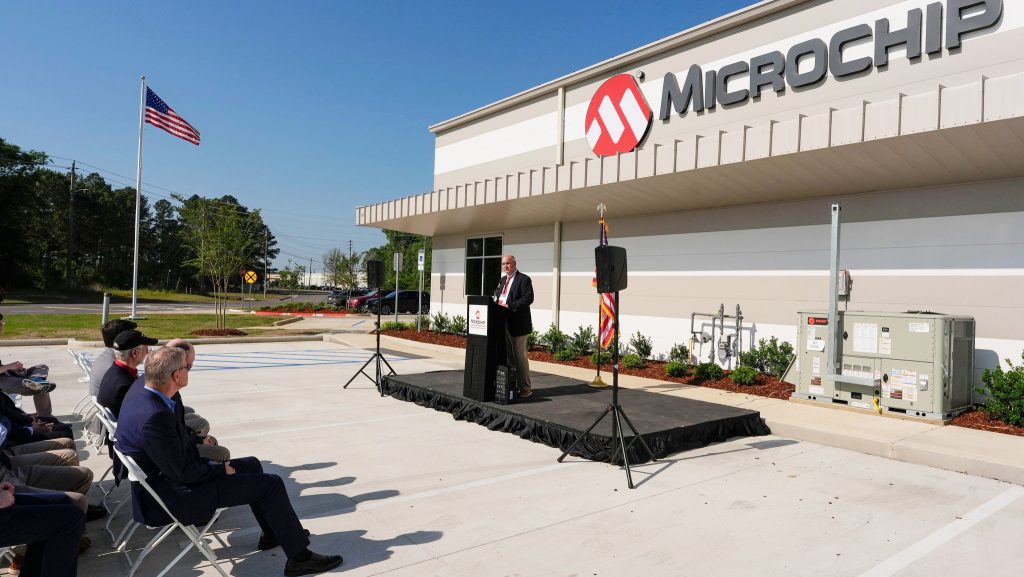
TUSCALOOSA — Alabama’s advanced manufacturing story grew a little bigger April 27 when Microchip Technology (Nasdaq: MCHP) announced it has opened a new facility in Tuscaloosa County dedicated to expanding production of its MHM-2020 Active Hydrogen Maser — one of the most precise timekeeping instruments on earth.
A hydrogen maser is an atomic clock that uses properties of hydrogen atoms to emit stable microwave frequencies for highly accurate timekeeping. These instruments are not a niche curiosity. They are the backbone of global infrastructure — actively contributing to Coordinated Universal Time (UTC), the worldwide standard for the time of day, and synchronizing power grids, cell phone networks, satellite communications, GPS ground stations, and deep-space tracking networks. As nations increasingly seek independent timescale systems to protect critical infrastructure from disruptions, demand for hydrogen masers is rising.
The new Tuscaloosa facility is approximately 15,000 square feet and includes temperature stability testing areas and a state-of-the-art research and development laboratory. Microchip’s Alabama roots run deep — the company has maintained a Tuscaloosa County presence since acquiring Frequency Time Systems in 1996, giving this expansion a foundation of three decades of in-state operations.
“This facility in Tuscaloosa was a priority for Microchip, both to meet the growing customer demand for our hydrogen masers and to strengthen our collaboration with the University of Alabama’s Precision Navigation and Time Laboratory,” said Randy Brudzinski, corporate vice president of Microchip’s frequency and time systems business unit.
The university partnership is central to the expansion’s significance for Alabama. The collaboration leverages equipment sharing, student training, and advisory board participation with UA’s Quantime Laboratory. Dr. Thejesh Bandi, the lab’s principal investigator, noted the partnership has been three years in the making. “This expansion of their local manufacturing demonstrates our shared commitment to advancing timing and frequency solutions,” Bandi said.
That model — private industry anchored by a university research partnership — is exactly the kind of economic development that creates lasting value. It produces not just jobs, but also trained graduates, institutional knowledge, and a regional reputation for technical capability that attracts the next company.
For students and workers in Tuscaloosa and across Alabama, the takeaway is practical: high-tech manufacturing requires precision-minded talent — technicians, engineers, and lab professionals. Communities that invest in building those pipelines are the ones that win these expansions.