

The selection of Tennessee State offensive lineman Lachavious Simmons as the only black college player in last week’s 2020 NFL Draft evokes memories of a bygone time when HBCU players were much more prevalent in the league’s draft and their path to reach that status.
The BCSP begins a series this week on the history of HBCU products in the NFL Draft.
IT BEGAN IN THE ’50s
The first time an HBCU player appeared in the NFL Draft was in 1950, 16 years after the league’s debut draft in 1936.
North Carolina A&T running back Bob “Stonewall” Jackson is the first HBCU alumnus to be drafted by a National Football League (NFL) team when he was selected by the New York Giants in the 16th round (202nd overall) of the 1950 NFL Draft.
After his two-year stint in the NFL, Jackson spent most of his career working in athletics at North Carolina Central University. He also coached football, basketball, track, and tennis at Johnson C. Smith, St. Augustine’s, Shaw and Texas Southern Universities. He also served as a faculty member, trainer, and equipment manager at some of these institutions Kentucky State running back Alvin Hanley was the second black college player to appear on the draft rolls after being picked by the Los Angeles Rams in the 30th and final round in 1953. There is no record that Hanley ever played in the league.
That was the same year that legendary quarterback Y. A. Tittle out of LSU was taken by San Francisco in the first round. Tittle had played two years in the professional All-American Football Conference (AAFC) before the league folded. He made his fame playing for the 49ers and later the New York Giants.
HBCU selections were sparse and confined to only the later rounds for the first few years. Only two were taken in 1952 and three in 1953. But of those three in 1953, a couple are names familiar in black college circles.
Roosevelt Brown an offensive tackle out of Morgan State was selected by the New York Giants in the 27th round of that year’s draft. “Rosey,” as he was called, was the 321st selection overall but went on to play 13 years for the Giants, missing only four games.
Brown, who was an assistant coach and longtime and beloved scout for the Giants after his retirement, once asked me while he and I worked in the press box of a North Carolina A&T football game, ‘Do you know the first black captain of an NFL football team?’ I answered, ‘no.’ He said, ‘you’re looking at him.’
He then asked, ‘Do you know who was the first black college graduate in the NFL Hall of Fame?’ Again, I answered in the negative but the answer was obvious.
Brown, a Charlottesville, Va. native and two-time all-CIAA player at Morgan State, stood about 6-3 and weighed about 255 pounds during his playing days – small even at that time for an NFL lineman – but was selected as a firstteam All-NFL player eight consecutive years and was also selected to play in the Pro Bowl nine times. He is a member of 1975 Pro Football Hall of Fame class.
Marion Motley, an outstanding running back and linebacker who played form 1946 to 1955, was in the 1969 Hall of Fame class before Brown. But Motley went to South Carolina State for only one year before transferring to the University of Nevada. Motley was the second African-American inducted into the Hall.
Record-setting defensive back Emlen Tunnell, who played from 1948-61 with the New York Giants and Green Bay Packers and was the all-time leader (now second) in career interceptions (79), was the first African American in the Hall of Fame. Tunnell was also the first to play for the New York Giants and was a teammate of Brown’s.
The other familiar name from the 1953 draft is Bethune-Cookman legend Jack “Cy” McClairen.
McClairen, a wide receiver on the gridiron and a basketball standout at B-CU, was taken by Pittsburgh in the 26th round and played six years in the league earning one Pro Bowl designation. He returned to the university and spent the next 50-plus years of his life serving his alma mater as head basketball coach for 15 years, head football coach for 32 years and athletics director, at one stretch holding down all three positions simultaneously.
In 1954, again there was just one HBCU players selected.
But in 1955, that number rose to eight with running back Leo Lewis out of Lincoln University of Missouri going to Baltimore in the eighth round. Known as “The Lincoln Locomotive,” Lewis rushed for over 4,500 yards and 64 touchdowns during his college career. He played professionally in the Canadian Football league.
The year of 1956 saw Penn State’s Lenny Moore go as a first-round pick of the Baltimore Colts. In the fifth round, Chicago selected outstanding running back Willie Gallimore of Florida A&M, to that point the highest an HBCU product had been selected.
Also among the eight black college players taken in that draft was Grambling standout defensive lineman Willie Davis by Cleveland.
Davis played just two years for the Browns before being traded to Green Bay in 1960. Davis became a stalwart defensive end for the Packers earning six all-Pro designation and winning five NFL championships under head coach Vince Lombardi. He was inducted into the Hall of Fame in 1971.
The HBCU draft numbers dipped to just three in 1957 and stayed in single digits for another year as seven HBCU products went off the boards in 1958.
Among those were Maryland Eastern Shore defensive back Johnny Sample and North Carolina Central defensive tackle “Big John” Baker.
Sample became the only player in pro football history to win a league title in the NFL and AFL and win a Super Bowl, later with the New York Jets. Baker later became the sheriff of Wake County, North Carolina from 1978 to 2002, becoming the first African-American sheriff in North Carolina since the Reconstruction era.
In 1959 the black college draft numbers went into double-digits for the first time as 13 players went off the boards. The earliest was Jackson State end Bill Connor in the eighth round to the LA Rams. But none made a particular mark in the league.
THE ’60s – A NEW DAY
The AFL was a new professional league and held its first draft in 1960, drastically changing the direction and prospects for HBCU products. Because players were often drafted in both leagues, there was now competition and bidding wars for talented players.
Nine HBCU players were taken in the 1960 NFL draft including Maryland State defensive tackle Roger Brown by Detroit of the NFL in the ninth round and the New York Titans of the AFL also in the ninth round. Brown, who became noted as the first pro football player to top 300 pounds, began his career in Detroit.
The 1961 draft saw the HBCU numbers reach double-digits for the second time as 13 players went off the board. There was a total of eight on the AFL rolls.
Huge Grambling lineman Ernie “Big Cat” Ladd at 6-9, 290 pounds, was taken by the Chicago Bears of the NFL in the fourth round and the AFL’s San Diego Chargers in the seventh round. Ladd opted to play for the Chargers and led them to four AFL championships in five years. He later played for Kansas City before beginning a long career in professional wrestling.
Also in the 1961 draft was future Hall of Famer David “Deacon” Jones, taken by the LA Rams out of Mississippi Valley State. The ‘Deacon’ is credited with inventing the term ‘sack’ for tackling the quarterback behind the line.
The 13 HBCU players in the 1962 NFL Draft included Grambling defensive lineman and future Hall of Fame Junious “Buck” Buchanan. He was taken in the 17th round by Green Bay as a future pick but decided not to come out that year.
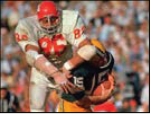
In 1963 he was again selected, this time in the 19th round by the New York Giants of the NFL but was the first overall pick in the AFL – a first for HBCU products and the first African-American ever to be the top pick – to the Kansas City Chiefs of the AFL. Buchanan played in 182 career games that included a string of 166 straight. As the Chiefs’ defensive right tackle, he played in six AFL All-Star games and two AFC-NFC Pro Bowls (14, NFL) and was a key player in the Chiefs’ win in Super Bowl IV over Minnesota. His name now adorns the FCS Defensive Player of the Year award.
The HBCU numbers rose to 18 in 1964 as future Hall of Famers Leroy Kelly out of Morgan State and Bob Hayes of Florida A&M came off the boards.
Kelly, a running back went to Cleveland in the eighth round and eventually took over the Browns’ ball-carrying duties when Hall of Famer Jim Brown retired. Hayes, a wide receiver and the 1964 Olympic 100-yard dash champion, was taken by the Dallas Cowboys in the seventh round.
Prairie View wide receiver Otis Taylor was a subject of a bidding way after he was selected by both the AFL’s Kansas City (4th round) and NFL’s Philadelphia (15th round). Taylor opted for the Chiefs.
With the forthcoming merger of the two leagues in 1967, the number of HBCU products going in the combined draft was about to take a precipitous jump.
That will be covered in next week in Part Two of the BCSP Series.
1965 (NFL, 18) Jefthro Pugh, ECSU,