

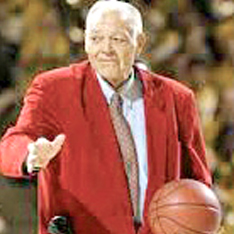

Clarence “Big House” Gaines is.
When Gaines, the legendary former Winston-Salem State University basketball coach and Kentucky native, was honored at a 2004 University of Kentucky basketball game at Rupp Arena – the sprawling UK home court in Lexington named in honor of its legendary coach – it brought to mind the strange history of race relations in this country and how sports, particularly black college sports, has impacted it.
Gaines was born in tiny Paducah, Ky., but had to leave the state to make his mark in life. And make one he did. He was appropriately and fittingly honored by (then) Kentucky head coach Tubby Smith (now the head coach at High Point), a black man.
In addition to the honor in Lexington, Paducah in 2017 renamed a street and erected a monument in Gaines’ honor. The celebration was part of the city’s annual August Emancipation Celebration event that honored Gaines and his family.
Rupp, the legendary Kentucky basketball coach known as “The Baron,” built the Wildcats into perhaps the nation’s premier program winning a then-record 876 games from 1930 to 1972.
Oft-remembered for his staunch opposition to integration, he got what some consider his comeuppance in the 1966 NCAA Championship Game at Cole Field House against Texas Western.
Before a national television audience that included this writer, five black Texas Western starters took the floor against Kentucky’s 26-1 top-ranked squad of lilly white players dubbed “Rupp’s Runts” in a game that most acknowledge changed the face of college basketball. It was the first time five white starters met five black starters in the title game.
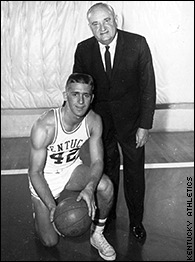
That Rupp already had four NCAA championships, was seen as the grumpy head of perhaps the greatest program in college basketball and was fairly or unfairly viewed as the symbol of opposition to integration, only added to the drama. Never mind the fact that unlike its Southeastern Conference counterparts, Kentucky routinely played teams with black players – not five black starters – and likely welcomed the challenge. For me, an 11-year-old basketball junkie from Danville, Va., as well as most of the nation, it was a morality play.
Texas Western methodically took apart Rupp and his ‘Runts’ on March 16, 1966, never surrendering the lead after going up early en route to a stunning 72-65 victory. Using seven black players and no whites for the entire game, Don Haskins’ squad ran around, past, through and over the UK darlings.
Though black players had been part of NCAA championship teams dating back to the early 1950s, Kentucky’s dismantling by an all black squad on such a national stage buried another bastion of white invincibility. It had all the symbolism of a modern-day Tiger Woods win at The Masters.
Gaines was there, along with many of his black college coaching peers. The Central Intercollegiate Athletic Association (CIAA), to which WSSU then (and now) belongs, was having its annual meeting in Washington, D.C., along with the National Association of Basketball Coaches that always meets on Final Four weekend.
“We knew there were five (black) kids,” Gaines said of the Texas Western squad. “A couple of them had gone to (North Carolina) A&T.” Actually, Neville Shed, a starting forward for Texas Western, had played for Gaines’ good friend and rival, head coach Cal Irvin at A&T. David Lattin, a center who dominated the inside play in the game, had played for Harold Hunter at Tennessee State.
Kentucky scoring leader Pat Riley – yeah, that Pat Riley – reportedly said of Lattin, “In those days, players didn’t dunk. I hadn’t seen anyone dunk. But these guys came out, and after they had dunked on me about three times, I knew they had a lot more to accomplish than we did.”
What an understatement. I guess Riley had never seen a black college game.
Only a year later Gaines would become the first black coach to win an NCAA basketball title of any kind when his Earl Monroe-led Rams won the 1967 Small College title. He went on to win 828 games in his 47-year career, all at WSSU, which ended with his retirement in 1993.
Gaines led the Rams to 18 20-win seasons and 11 Central Intercollegiate Athletic Association (CIAA) titles. When he retired from WSSU in 1993, only Rupp had amassed more wins. Gaines was inducted into the Basketball Hall of Fame in 1982.
Asked if Rupp’s reputation as a racist was justified, Gaines said there’s no doubt.
“I know it was true. I was raised in Kentucky,” said Gaines. “I waited tables. I was a bellhop.” In other words, he had seen it firsthand.
The man (Rupp) was an excellent teacher,” said Gaines, who attended one of Rupp’s clinics at the University of Illinois Carbondale. “I guess that with the personnel that he had and with the
system that he used, it was almost impossible to beat him at that time. He was an excellent coach and an excellent teacher.
“The only thing that we thought about him is, like with all of the coaches in the South, they all were racists.
“Oh, we’ve gone through hell, man,” said Gaines.
Gaines and a legion of black college coaches had paved the way for that fateful day in 1966.
By winning three straight NAIA titles from 1957-59 at Tennessee State, John McLendon became the first coach to accomplish that feat and also forced integration of tournament accommodations when he threatened to not bring his defending champion team back to the tournament in 1958 unless they stayed in the same hotel as the other teams.
McLendon and his cohorts then worked to end the practice of putting all the black college teams in the same district – the infamous District 29 – where they had to beat each other before taking on the predominantly white schools.
This, no doubt, opened the doors for Grambling State under Fred Hobdy to win the 1962 NAIA crown and Prairie View A&M under LeRoy Moore to come away with the title in 1963, not to mention Gaines’ title in 1967.
It also opened the door for Smith 30 years later to become the head coach at Rupp’s former school.
Thank God for coaches like Gaines and for coaches like Tubby Smith who remembered and honored them.