


FHA opens doors for thousands of minority homebuyers, yet Black homeownership continues to trail white households by more than 30 percentage points nationally as affordability and wealth gaps persist.
By SPEAKIN’ OUT NEWS
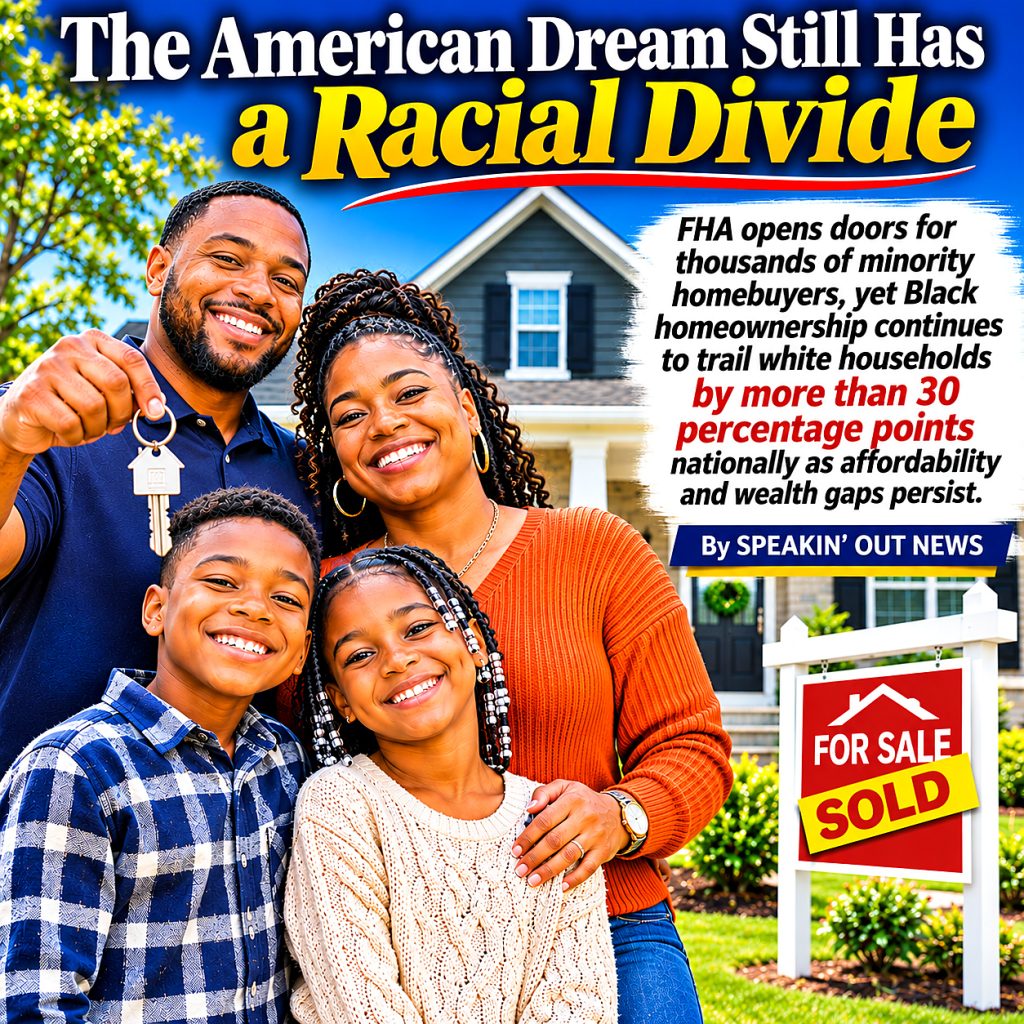
WASHINGTON — For millions of Americans, owning a home represents financial security, independence and the opportunity to pass wealth to the next generation. But for Black families, that cornerstone of the American Dream remains far more difficult to achieve.
A new federal report reveals both progress and persistent inequality. The Federal Housing Administration helped more than 935,000 Americans obtain home financing during fiscal year 2026, including more than 530,000 first-time homebuyers, according to the U.S. Department of Housing and Urban Development.
Minority borrowers accounted for 36.9% of FHA-insured forward mortgages, while first-time buyers represented more than 83% of FHA-insured home purchase loans. Those figures underscore the importance of government-backed financing for households seeking an affordable path into homeownership.
Yet behind those encouraging numbers lies a troubling reality: America’s racial homeownership divide remains enormous.
The latest U.S. Census Bureau figures show that during the third quarter of 2026, 75.1% of non-Hispanic white households owned their homes, compared with just 44.4% of Black households. Hispanic homeownership stood at 48.1%.
That represents a 30.7-percentage-point Black-white gap nationally—a divide that reflects decades of unequal access to housing, income and accumulated family wealth.
A Lifeline for First-Time Buyers
FHA-backed mortgages remain particularly important because they offer lower down-payment requirements and more flexible credit qualifications than many conventional loans.
HUD Secretary Scott Turner praised the program’s role in helping Americans purchase homes, particularly first-time buyers.
“Under President Trump’s leadership, we are making meaningful strides in expanding homeownership opportunities for Americans,” Turner said in the agency’s November 16 announcement.
Turner described FHA as an important public-private partnership, while HUD reported that the mortgage insurance fund maintained a 10.29% capital ratio at the end of September.
But access to a mortgage does not necessarily mean families can afford the rising costs of ownership.
The Price of Being Left Behind
A February 2026 LendingTree analysis found that across the nation’s 50 largest metropolitan areas, Black homeownership stood at 43.6%, compared with 70.3% for white households.
The same research found that Black homeowners’ median property values were 22.8% below the national median for all homeowners, illustrating how disparities continue even after families purchase homes.
Matt Schulz, LendingTree’s chief consumer finance analyst, pointed to the financial barriers facing prospective Black buyers.
“Without sufficient income and decent credit, getting a home can be a major challenge,” Schulz said.
A separate October 2026 analysis from the Center for Responsible Lending’s affiliated research institute found that the estimated time needed for a Black aspiring homeowner to save for a starter home’s down payment and closing costs increased from 11 years in 2019 to 21 years in 2026.
For a typical renter family, the estimated savings period doubled from eight to 16 years.
These findings suggest that the challenge extends beyond mortgage approval. Many households struggle to accumulate enough savings to begin the purchasing process.
Black Borrowers Still Underrepresented
Research released in October by the National Community Reinvestment Coalition offers another warning.
Its analysis found that Black borrowers accounted for approximately 8.2% of home purchase loans in 2025, despite representing 11.9% of the adult population.
That share declined from 9.2% in 2022 and 2023.
The findings indicate that Black borrowers remain underrepresented in the mortgage market, even as government-backed programs continue providing critical financing opportunities.
Why It Matters in North Alabama
For families in Huntsville, Madison, Decatur and surrounding communities, the national debate carries practical consequences.
Rising home prices, limited savings and mortgage qualification requirements can complicate the transition from renting to ownership.
FHA financing may provide a pathway for first-generation buyers, particularly families without substantial financial assistance from relatives.
Homeownership can also create opportunities to build equity, improve long-term financial stability and transfer assets to children.
Prospective buyers should compare FHA and conventional mortgage offers, investigate down-payment assistance through the Alabama Housing Finance Authority and consult HUD-approved housing counselors before making major financial commitments.
The central question is no longer simply how many Americans receive mortgages. It is whether the opportunities created by those loans can meaningfully narrow the racial wealth divide.
For Black families pursuing the American Dream, getting the keys is an important beginning. Ensuring that more families can afford those keys—and keep them—remains the larger challenge.