

The sacrifices of voting-rights pioneers frame today’s research as Madison and Morgan counties record declining Black participation
By SPEAKIN’ OUT NEWS
HUNTSVILLE, Ala. — Are candidates investing in relationships with Black communities, or assuming their support or opposition without showing up? Have they met with local minority chapters or accepted invitations to community forums? Which Black churches, neighborhood organizations and businesses have they visited? How much have they spent with Black-owned media, including print, radio, and digital advertising? Have they participated in debates or public question-and-answer sessions? Declining participation raises questions about outreach and accountability. Candidates of every party should explain where they have appeared, whom they have heard, and how they have responded to concerns voiced by all residents. Nevertheless, the Black vote cannot be overlooked or taken for granted.
That question carries weight in Alabama, where the struggle for voting rights came at a profound human cost. Behind the participation figures are generations who challenged intimidation, discrimination, and violence to secure a voice in their government.
Before turnout reports and online registration forms, people stood outside courthouses, risking their jobs, freedom, and lives for the right to vote.
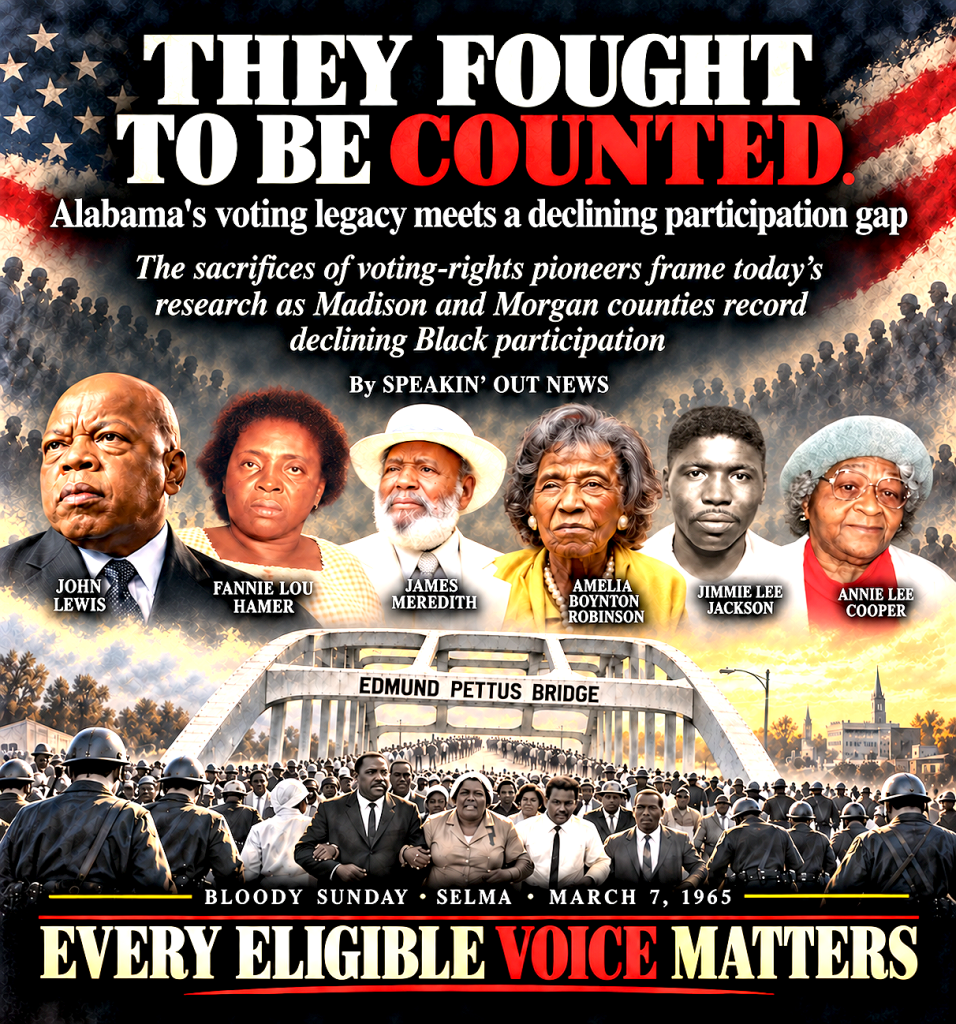
Annie Lee Cooper waited for hours. Amelia Boynton Robinson was beaten unconscious. Jimmie Lee Jackson died after a state trooper shot him. John Lewis carried the scars of Bloody Sunday into a lifetime of public service.
Their experiences reveal the human cost of securing equal access to the ballot. Today, Alabama’s election records show hundreds of thousands of Black residents participating, alongside declines that deserve attention.
The people behind the right
Cooper repeatedly attempted to register in Selma after having registered in other states.
“Once I stood in line from 7 a.m. to 4 p.m., but never got to register,” she recalled, according to the SNCC Digital Gateway.
After joining Selma’s Oct. 7, 1963, Freedom Day registration effort, Cooper lost her job. On Jan. 25, 1965, another registration attempt ended in a confrontation with Sheriff Jim Clark and her arrest.
Boynton spent decades helping rural Black residents confront registration barriers. According to the National Park Service, her office displayed a sign reading: “A Voteless People is a Hopeless People.”
On March 7, 1965, police beat her unconscious during the peaceful march remembered as Bloody Sunday. She survived and continued the struggle.
Jackson was a 26-year-old father, church deacon and voting-rights activist from Marion, Alabama. On Feb. 18, 1965, a state trooper shot him while he tried to protect his mother during violence surrounding a demonstration.
He died Feb. 26. His death helped inspire the Selma voting-rights marches.
John Lewis and “Good Trouble”
Lewis helped lead marchers across Selma’s Edmund Pettus Bridge on March 7, 1965. State troopers attacked the demonstrators, fracturing his skull.
He survived, later served in Congress and became known for describing nonviolent resistance to injustice as “good trouble.”
“Get in good trouble. Necessary trouble, and help redeem the soul of America,” Lewis said on March 1, 2020, during the Bloody Sunday anniversary commemoration at Selma’s Edmund Pettus Bridge, according to CNN’s contemporaneous coverage.
In Mississippi, Fannie Lou Hamer endured retaliation and a brutal jail beating. In testimony on Aug. 22, 1964, before the Democratic National Convention’s credentials committee, she explained:
“All of this is on account of we want to register, to become first-class citizens.”
James Meredith’s connection to Huntsville
The struggle continued after passage of the Voting Rights Act of 1965.
In June 1966, James Meredith began his “March Against Fear” from Memphis to Jackson, Mississippi, encouraging Black voter registration and challenging racial intimidation. A gunman shot and wounded him near Hernando on June 6, 1966. Other activists continued the march, and Meredith later rejoined it.
His story connects directly to Huntsville: his son, John Meredith, serves as the city’s District 5 councilmember, linking his father’s legacy of challenging racial barriers to public service in North Alabama today.
North Alabama’s picture
Madison County recorded 42,305 Black voters in 2024, compared with 43,274 in 2020 — a decrease of 969, or approximately 2.2%.
Morgan County recorded 5,240 Black voters in 2024, down from 5,835 in 2020. Its decrease of 595 represented approximately 10.2%.
Statewide, recorded Black participation declined from 562,519 in 2020 to 511,534 in 2024 — approximately 51,000 fewer voters between those presidential elections.
These figures describe changes in participation counts, rather than turnout rates. Determining turnout rates requires matching the number who voted with registered or eligible voters from the same election period. County figures also should not be presented as city-specific results for Huntsville or Decatur.
The state’s September 2026 registration report lists 1,000,964 Black registered voters statewide, including 871,942 classified as active and 129,022 as inactive. Madison County’s combined total was 83,671, including 70,616 active and 13,055 inactive registrants.
Those current registration figures cannot be used to calculate turnout in the 2024 election.
A widening participation gap
A Brennan Center for Justice analysis estimated that Alabama’s white–Black turnout gap increased from nine percentage points in 2022 to 13 points in 2024, its widest since at least 2008.
The center found that Black turnout declined approximately six percentage points between 2020 and 2024, compared with about one point for white voters. It identified restrictive voting laws as a likely contributor but acknowledged it could not pinpoint what caused the gap to widen.
Why some residents do not vote
National Census Bureau findings suggest that nonparticipation involves both practical difficulties and dissatisfaction.
Among registered, non-Hispanic Black adults nationwide who did not vote in 2024, 23.6% cited lack of interest or a belief that voting would not make a difference. Another 18.2% cited illness or disability, 16.6% reported being too busy or having scheduling conflicts, and 14% disliked the candidates or campaign issues.
These findings are national, not Alabama-specific, and do not explain the experiences of people who were unregistered.
Alabama’s procedures also require planning. The state does not offer a general early-voting period or no-excuse absentee voting. Qualifying absentee voters must meet application and return deadlines, and ballot affidavits must be notarized or signed by two witnesses.
For residents balancing work, caregiving, illness, or transportation needs, understanding those requirements can be essential to participation.
Information and access matter
Nonpartisan assistance available to all eligible residents can address practical obstacles through clear registration information, polling-location guidance, accessible transportation, and explanations of absentee procedures.
Alabama provides free photo voter identification for qualifying residents who lack an accepted ID. The state also accepts requests for mobile ID events and home visits. People uncertain about eligibility after a criminal conviction can consult official registration and voting-rights restoration resources.
The 2026 general election has not yet occurred, so we cannot measure this year’s general-election participation.
The last day to register for Alabama’s general election is Monday, Oct. 19, 2026. Election Day is Tuesday, Nov. 3, with polls open from 7 a.m. to 7 p.m.
Residents can register, verify their status, and find official election information at AlabamaVotes.gov.
Every eligible voter, regardless of political affiliation, can make an independent, informed choice. Remember the people behind the right. Review the ballot. Confirm your registration and polling place. Prepare to participate.