


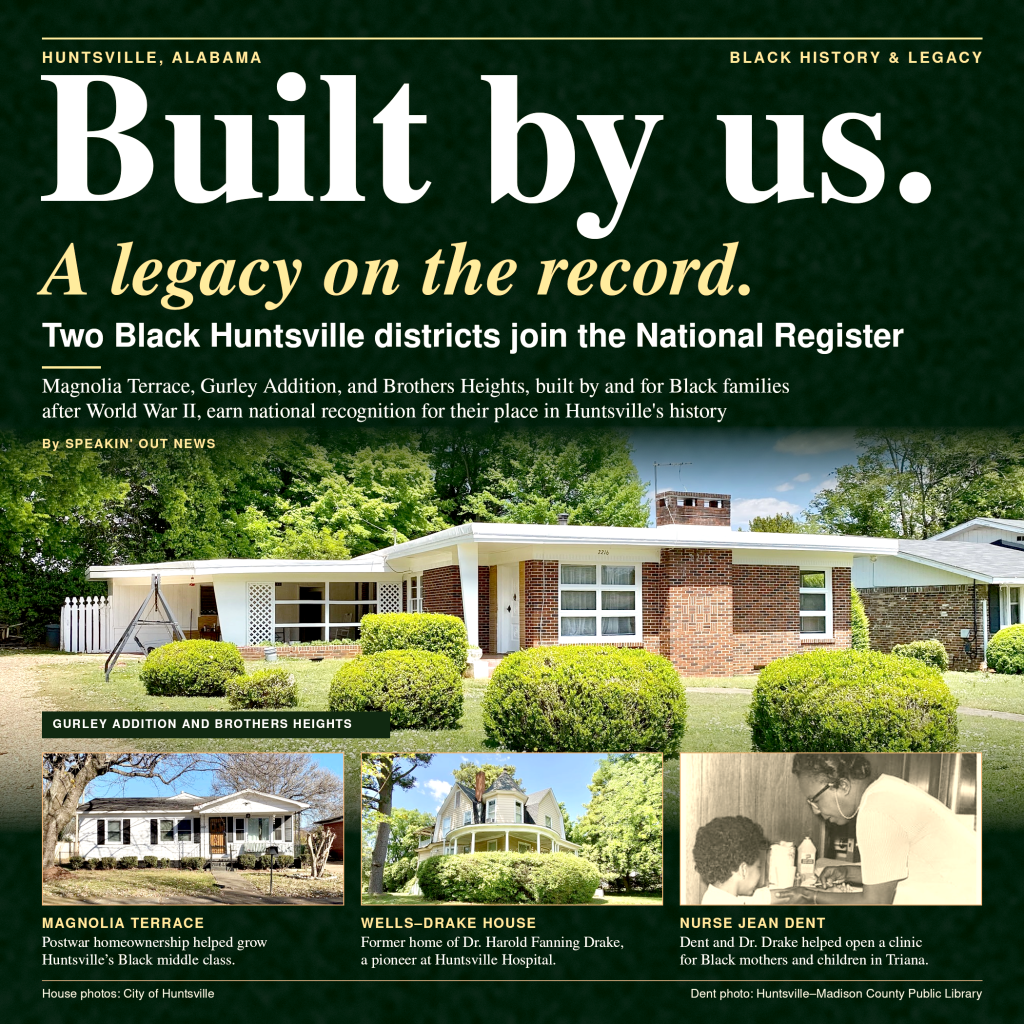
Long before Huntsville became the Rocket City, Black families in the northwest part of town built something of their own: neighborhoods where they could buy homes, raise children, and put down roots at a time when much of the city was closed to them.
Now two of those neighborhoods have a permanent place in the nation’s historic record. The Magnolia Terrace Historic District and the Gurley Addition and Brothers Heights Historic District were listed in the National Register of Historic Places on Nov. 18, the City of Huntsville announced Nov. 23. The listing followed approval by the Alabama National Register Review Board in September and a final review by the National Park Service.
“These neighborhoods tell an important part of Huntsville’s story that deserves to be recognized and preserved,” said City Preservationist Katie Stamps.
Built by Black developers, for Black families
The two neighborhoods sit side by side, north of Holmes Avenue and west of Pulaski Pike, and together include more than 250 properties. But each has its own story.
Gurley Addition and Brothers Heights began developing in 1946. According to the city, Black developers planned and financed the neighborhood, giving Black residents a path to homeownership and stability while many were being pushed out of established neighborhoods near downtown. The district keeps much of its original character, with postwar cottages, minimal traditional homes, and ranch-style houses built from the 1940s through the 1960s.
Magnolia Terrace followed in 1950. It became home to Huntsville’s growing Black middle class, including families who came for jobs at Redstone Arsenal and families displaced by urban renewal. Its curving streets, landscaped yards, and midcentury homes reflected the era’s suburban planning.
Over the years, the neighborhood was home to teachers from Councill High School, professors from Alabama A&M, and local business owners, according to the city. Nearby, the Wells-Drake House on Stanley Drive, the oldest structure in the area, once belonged to Dr. Harold Fanning Drake, the first Black doctor to receive admitting privileges at Huntsville Hospital.
St. Joseph Catholic School, which served Black children during segregation, helped draw families to both neighborhoods. City records also describe it as the first school in Huntsville to integrate.
History that nearly disappeared
The recognition matters because so much of Black Huntsville’s built history is already gone. City preservation officials have said urban renewal and downtown expansion led to the demolition of many structures tied to the Black community.
Both neighborhoods grew during Huntsville’s rapid expansion after World War II, when segregation, discriminatory lending, and urban renewal limited where Black families could live, the city said.
“As Huntsville grew into an aerospace and defense center, Black families were building strong communities of their own, often overcoming significant barriers to homeownership,” Stamps said. “These designations honor their contributions and help ensure their history is not forgotten.”
District 1 Council Member Michelle Watkins welcomed the recognition for residents whose families helped establish these communities. “These neighborhoods are more than streets and houses. They’re places where families put down roots, raised their children and built a better future, even when opportunities weren’t equal,” Watkins said.
A community effort years in the making
The listing caps work that began years ago. In 2021, the city announced a survey of Magnolia Terrace funded by the Alabama Historical Commission and led by historic preservation specialist Dr. Caroline Swope, with help from current and former residents. In 2025, the city approved a $35,000 agreement with Swope to prepare the nominations, with a commission grant covering 60% of the cost and the city paying 40%.
Retired educator Brenda Barley Chunn, who was raised in Magnolia Terrace and helped inform residents about the survey, said in 2021: “This is exactly the right time to record and recognize our history.”
What it means for homeowners
National Register listing is an honor, not a new set of rules. The city has said listing does not impose regulations or require homeowners to change their properties. It can, however, make qualifying preservation projects eligible for certain incentives.
Families with old photographs, documents, or stories about either neighborhood can share them with the City of Huntsville’s historic preservation office, helping make sure the next generation knows who built these streets.
“It’s important that we remember the people who helped shape Huntsville and preserve their stories for future generations,” Watkins said.


