


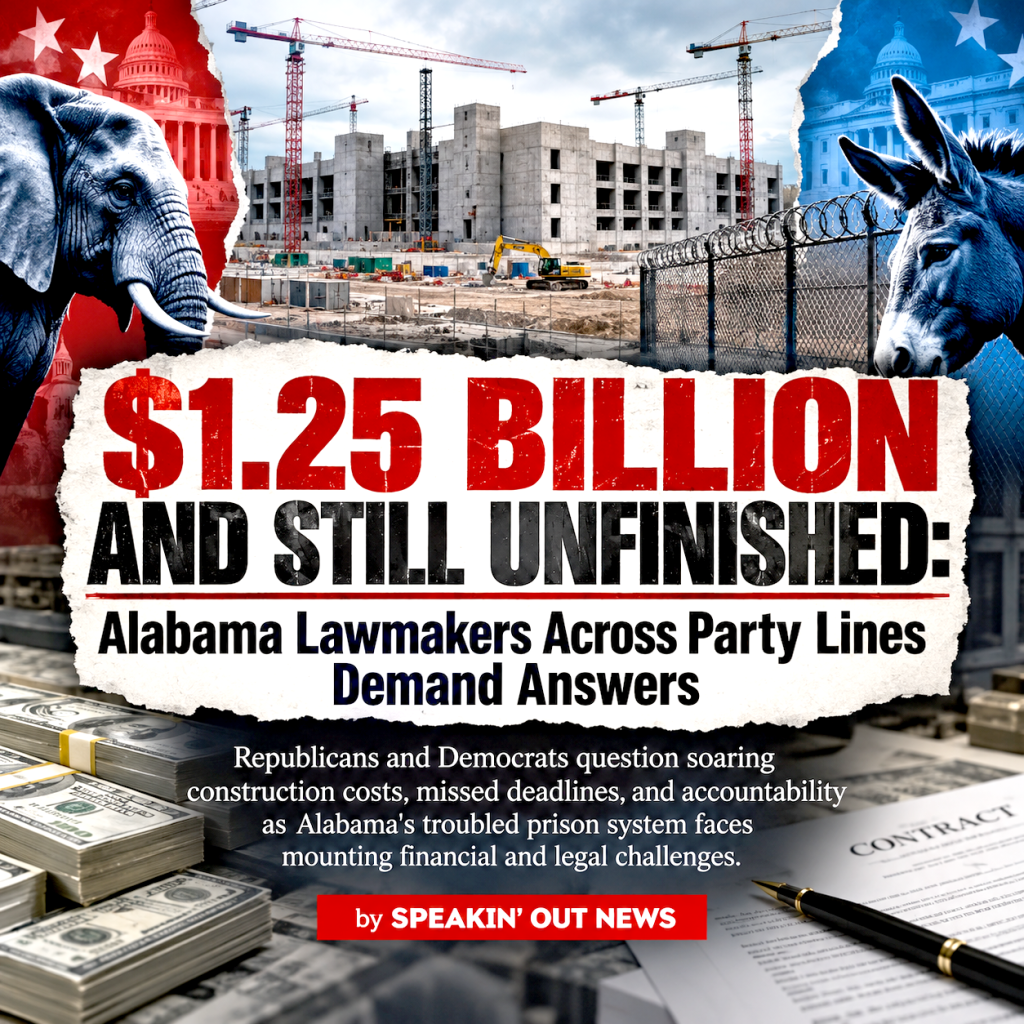
MONTGOMERY, Ala. — Alabama’s $1.25 billion prison project has become a flashpoint for lawmakers across party lines as rising costs, missed construction deadlines and longstanding problems inside the state’s correctional system fuel demands for greater accountability.
The Governor Kay Ivey Correctional Complex in Elmore County, designed to house 4,000 incarcerated men, missed its October 15 completion deadline. In an October 20 announcement, the Alabama Department of Corrections (ADOC) reported the facility was more than 85% complete but provided no new completion date.
Republican lawmakers are emphasizing contractor accountability and completion, while Democratic critics question whether billions in construction spending will produce meaningful improvements in Alabama’s prisons.
From $623 Million to $1.25 Billion
In 2021, lawmakers approved a $1.3 billion prison construction package, including $400 million in federal pandemic relief funding.
The plan called for two 4,000-bed men’s prisons in Elmore and Escambia counties to replace aging correctional facilities.
The Elmore project, initially estimated at approximately $623 million, has grown to a projected $1.25 billion.
Reporting by the Alabama Reflector and Alabama Political Reporter attributes the escalating expenses partly to inflation and higher-than-anticipated construction costs.
The facility will include 54 buildings, approximately 1.4 million square feet of construction, and medical, mental health, and vocational education facilities.
Rising costs have consumed nearly all the money originally allocated for both prisons, forcing state officials to seek additional financing.
Contractor Faces Millions in Damages
Montgomery-based Caddell Construction missed the October deadline after the original May 2026 completion target had already been postponed.
According to ADOC, the contractor owes approximately $14.2 million in contractual damages. Another $7.1 million could become due November 16 if construction remains unfinished.
The Alabama Corrections Institution Finance Authority has withheld contractor payments and applied funds toward the damages already due.
Under its design-build agreement, Caddell remains responsible for completing construction at the guaranteed maximum price, subject to contractual provisions.
State officials say they continue assessing the schedule and potential financial implications.
Republicans and Democrats Raise Concerns
State Rep. Rex Reynolds, R-Huntsville, chairman of the House Ways and Means General Fund Committee, has emphasized finishing the prison rather than abandoning the project.
“We want Caddell to be successful,” Reynolds told the Alabama Reflector on October 16. “We want to stay engaged to get this prison done.”
Sen. Greg Albritton, R-Atmore, chairman of the Senate General Fund committee, previously expressed confidence that contractual protections would limit additional taxpayer exposure.
“If there are delays, as I understand it, those delays would be at the cost of the vendor, not to the state,” Albritton told the Alabama Reflector in July.
Democratic Rep. Chris England of Tuscaloosa has raised broader concerns about the state’s correctional leadership and its ability to manage the transition into the new facility.
Speaking to the Alabama Reflector following the missed deadline, England questioned whether the current administration should oversee that transition.
The lawmakers’ positions reflect different priorities, but their statements underscore scrutiny of the project’s cost, schedule and management.
Second Prison Creates Additional Financial Pressure
The Escambia County facility presents another substantial expense.
According to the Alabama Reflector, lawmakers approved additional borrowing in 2025 after the Elmore project consumed nearly all the original construction appropriation.
The financing challenge raises questions about future debt obligations and the state’s ability to maintain both new and existing facilities.
With billions committed and no confirmed completion date, Alabama faces a fundamental question: Will its investment deliver safer prisons and lasting reform, or leave taxpayers financing an increasingly expensive system with familiar problems?


