


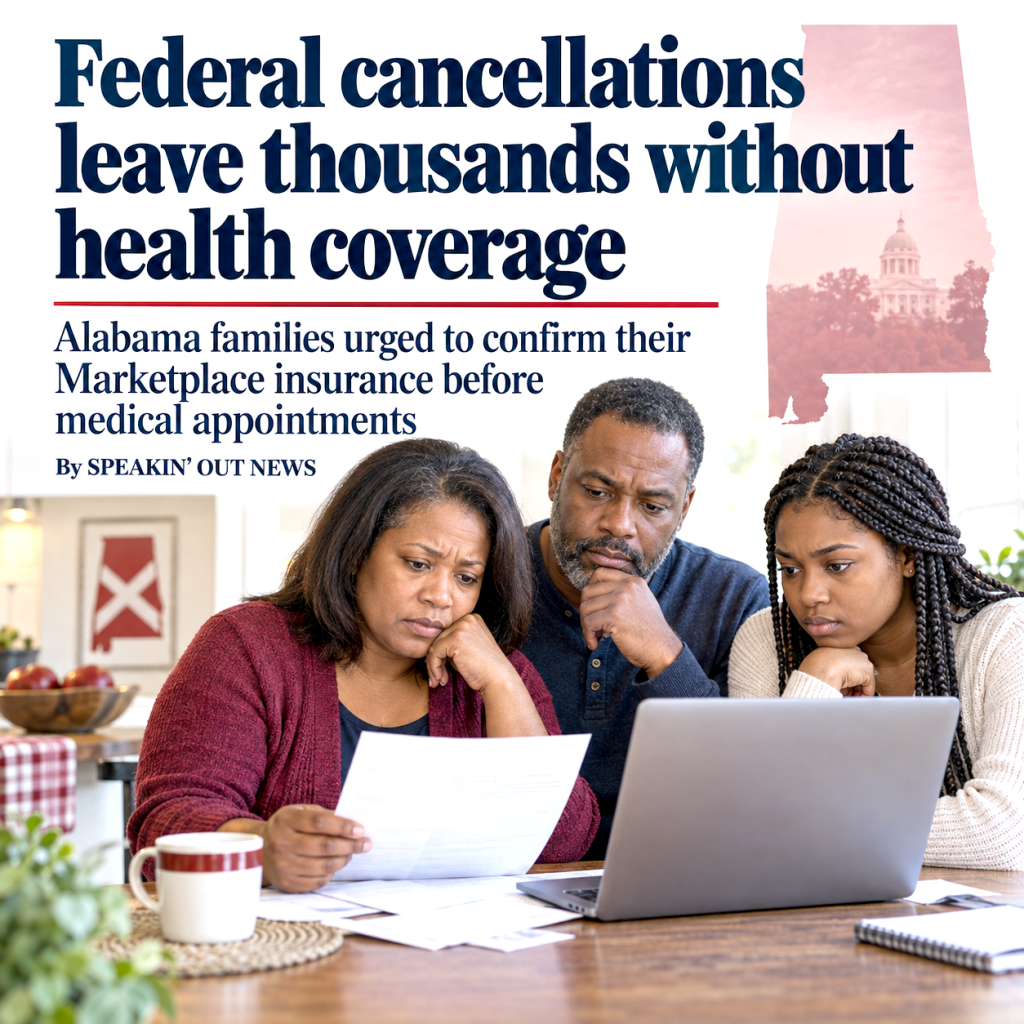
Hundreds of thousands of Americans may discover that the health insurance card in their wallet no longer reflects active coverage after a sweeping federal effort targeted questionable Affordable Care Act enrollments.
The Centers for Medicare & Medicaid Services canceled approximately 315,000 Marketplace policies covering about 760,000 people in August. Federal officials cited missing citizenship or immigration documents, unauthorized enrollments and applications suspected of containing inaccurate or fraudulent information.
The cancellations could carry serious consequences for families who do not learn about the change until they arrive at a doctor’s office, pharmacy or hospital. A terminated policy can leave patients responsible for the full cost of care, interrupt prescription refills or delay preventive screenings and treatment for chronic illnesses.
For Alabama, the announcement is especially significant. CMS reported that 455,776 Alabamians selected Marketplace plans during the 2026 open-enrollment period. That is nearly one out of every 11 state residents. Federal officials have not released a state-by-state breakdown showing how many of the 760,000 affected consumers live in Alabama.
Alabama already faces a coverage challenge
Even before the federal cancellations, 8.2% of Alabama residents lacked health insurance in 2024, according to data compiled by America’s Health Rankings. Alabama also remains one of 10 states that have not adopted the Affordable Care Act’s full Medicaid expansion, leaving some low-income adults with limited pathways to affordable coverage.
Coverage losses are not felt equally.
Nationally, 10.1% of Black people under age 65 were uninsured in 2024, compared with 6.8% of White people, according to KFF. Hispanic residents had an uninsured rate of 18.4%. Those disparities matter in Alabama, where Black residents comprise more than one-fourth of the population and already experience higher rates of diabetes, high blood pressure and other conditions requiring consistent medical care.
Young adults are vulnerable as well. Americans ages 19 to 25 have historically recorded the highest uninsured rate among age groups because many work in jobs that do not provide benefits or are transitioning between school and employment.
Older adults who have not yet reached Medicare eligibility also face particular risks. People ages 55 to 64 often use Marketplace coverage because they retired early, lost employer insurance, or run small businesses. Research examining the individual insurance market found that age 64 was its most common enrollee age—underscoring how important Marketplace plans can be during the years immediately before Medicare begins.
Federal officials target suspected fraud
Vice President JD Vance said the government is trying to ensure subsidies go only to people who qualify. Officials estimated that canceling the questioned enrollments could save approximately $2.2 billion.
CMS also barred 569 insurance brokers accused of submitting statistically implausible numbers of applications or applications missing identifying information. The agency announced a temporary freeze on new Marketplace broker registrations through Feb. 1, 2027.
Federal officials say some consumers were enrolled without permission, switched into different plans without their knowledge or listed with incorrect income and household information. Such activity can affect medical bills and create tax problems if premium subsidies were obtained using inaccurate information.
However, insurance professionals warned against treating every disputed enrollment as intentional fraud.
“A blanket moratorium on new agent and broker registrations would punish legitimate professionals instead of targeting the bad actors responsible for fraud,” said Mychal Walker, president of the National Association of Benefits and Insurance Professionals. The organization called for enforcement focused on specific offenders while preserving access to reputable agents.
What Alabama consumers should do now?
Alabama residents with Marketplace insurance should not wait until their next medical appointment to confirm coverage.
Consumers should log into their HealthCare.gov account, check their enrollment status and review all electronic messages and mailed notices. They should also contact their insurance company directly to confirm that the policy is active and that premiums are current.
HealthCare.gov generally gives applicants 95 days to verify citizenship or immigration status and 90 days to resolve other inconsistencies, such as household income. The consumer’s eligibility notice includes the exact deadline. Failure to provide the requested documents can result in losing coverage or financial assistance.
Anyone who believes coverage was canceled incorrectly can request an appeal through the Marketplace. Consumers should save cancellation notices, payment records, identification documents, and notes from every telephone conversation.
Help is available at HealthCare.gov or by calling the federal Marketplace at 1-800-318-2596. The TTY number is 1-855-889-4325. Alabama residents may also seek assistance from a trusted, licensed enrollment counselor or insurance agent.
The most important step is verification. Families should make certain their coverage is active before scheduling nonemergency care—and act immediately if their account shows an unfamiliar broker, an unauthorized plan change, or a termination they do not understand.


