


by Alabama News Network Staff
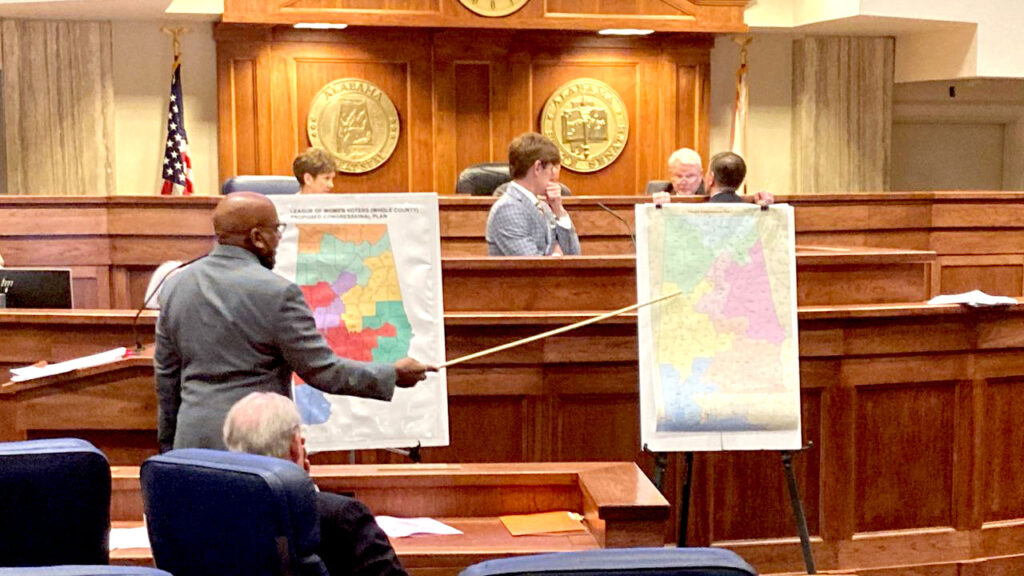
The congressional district plan approved by the Alabama Legislature during a special session last week already faces challenges from two federal lawsuits.
Both lawsuits claim the new map, which maintained Alabama’s ratio of one majority Black district out of seven, does not hold up under federal law in a state where Blacks make up 27% of the population.
District 7 remained Alabama’s lone majority-Black district, as it has been since a court-ordered plan in 1992. The lawsuits claim properly drawn maps would give Black voters an opportunity to elect a candidate of their choice in two of the seven districts.
The plaintiffs in one lawsuit, filed in U.S. District Court in Alabama’s Northern District, include Democratic state Sens. Bobby Singleton and Rodger Smitherman, as well as Black voters in several Alabama counties. They filed the lawsuit in September and updated it after the Legislature approved new maps on Nov. 3.
They say the plan approved last week intentionally dilutes Black voting strength by splitting counties to racially gerrymander Districts 2, 6, and 7, a violation of the principle of trying to keep counties whole.
The lawsuit claims the Legislature could have fixed what the plaintiffs say is unconstitutional racial gerrymandering by adopting a plan that splits no counties and that would create two swing districts where Blacks would make up more than 40% of the voting age population instead of having a single district with majority Black population.
Under that plan, which was proposed as Senate Bill 10 by Singleton and Smitherman during the special session, the Black voting age population in District 7 would be 49.9%, down from the 54% in the plan the Legislature approved. But District 6 would have a Black voting age population of 42.3%, enough to give Black voters an opportunity to elect a candidate of their choice in a second district, the plaintiffs say.
Under the plan the Legislature approved, none of the majority white districts had Black voting age populations greater than 29%.
“The Whole County Plan in SB 10 was rejected because it would have increased the number of Districts in which black voters would have an equal opportunity to elect candidates of their choice,” the lawsuit says.
Sen. Jim McClendon, R-Springville, co-chair of the legislature’s re-apportionment committee, said during the special session that the SB 10 plan was flawed, in part because it would put two incumbent members of Congress in the same district, Reps. Gary Palmer, R-Hoover, and Terri Sewell, D-Birmingham. McClendon also said it would violate the Voting Rights Act because it would drop the Black population in District 7 to below 50%, eliminating the state’s only majority Black district.
The plan supported by the Republican majority in the Legislature was approved over opposition from Democrats. The Legislature is required to reapportion districts for Congress, the state House and Senate, and the State Board of Education after every census.
The Singleton/Smitherman lawsuit claims the plan passed by the Legislature is intentionally racially discriminatory and violates the 14th and 15th amendments. The plaintiffs ask the court to block the use of the plan and require implementation of a court-ordered plan to be used for next year’s elections.
Time to make changes is limited. The deadline for candidates to qualify with the Democratic and Republican parties is Jan. 28. The primary is May 24.
The second lawsuit, filed Nov. 4 on behalf of eight Black voters in U.S. District Court in Alabama’s Middle District, claims the congressional district plan passed by the Legislature violates the Voting Rights Act “because it strategically packs and cracks Alabama’s Black communities, diluting Black voting strength and confining Black voting power to one majority-Black district.”
The National Redistricting Foundation is supporting the lawsuit. The organization is a nonprofit affiliate of the National Democrat- ic Redistricting Committee, which is led by Eric Holder, who was attorney general under President Barack Obama, the Associated Press reported.
The plaintiffs claim the new district maps were passed during a “muddled and harried process” that gave lawmakers little time to evaluate the plans during the special session. The state only received the redistricting information from the Census Bureau in mid-August because of delays caused by the COVID-19 pandemic.
The legislature’s re-apportionment committee approved the congressional district map on Oct. 26, two days before the special session. The plan cleared the Legislature on Nov. 3 and was signed into law by Gov. Kay Ivey the next day.
“By combining cracked Black populations in CDs 1, 2, and 3, and unpacking CD 7, the Alabama map-drawers could have drawn two majority Black districts, as required by Section 2 of the Voting Rights Act,” the lawsuit says.
The lawsuit says District 2 could be a majority Black district by combining all of Montgomery County with Black Belt counties in west Alabama.
The lawsuit asks the court to declare the Legislature’s plan to be in violation of the Voting Rights Act and to order a new plan with two majority Black districts.
Today, U.S. District Judge Keith Watkins of the Middle District ordered the parties in the lawsuit to show cause why the case should not be transferred to the Northern District because he said the underlying facts and functional arguments in the two cases are almost identical.
McClendon and Rep. Chris Pringle, R-Mobile, the other co-chair of the reapportionment committee have said they believe the plan adopted by the Legislature follows the Voting Rights Act and other federal redistricting requirements. Both said they expected to defend the plan in court.