

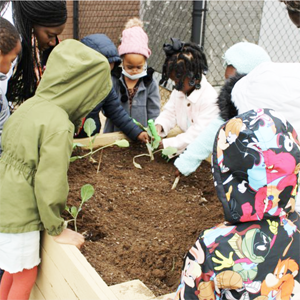
“Sunshine! Water! Dirt!” students yell out at Black Belt Community Foundation Head Start in Selma when their teacher asks what their garden will need to grow.
The class of ten students that range in age from three to five is planting foods suitable for winter – collard greens, kale and cabbage.
“We’re going to put our plants in the soil and watch them come to life,” their teacher explains.
Shovels and rakes are passed around the garden bed for students to plant their sprouts. Each day the class returns to water their vegetables until they’re ready to harvest some vegetables and cook lunch.
The preschool, located in Alabama’s Black Belt region, hopes young students will not only learn about the importance of healthy food, but also about how to be resourceful and food self-sufficient. The program is part of an expanding effort around the Black Belt to increase agriscience opportunities for students who live in a food insecure region.
“We want to keep them healthy and strong but also aware of the importance of these foods and what’s available to them in their communities,” said Theresa Kimbrough, the Head Start center director.
‘An issue that really hits home’
At BBCF Head Start, students not only grow food but also use produce for lessons on counting and using descriptive language. The school puts on a farmers market with kids playing the roles of cashier or shopper to understand basic economics.
The Black Belt Community Foundation, which administers the school in Selma and Head Start programs in three other Black Belt counties, is hoping to expand more agriscience education into K-12 schools in the region.
The organization has increasingly focused on building sustainable food systems since the pandemic, when they shifted gears from running their community programs to making sure residents in the region had meals everyday.
“Food insecurity in the Black Belt is an issue that really hits home for us especially as it affects our children and their families…during the onset and height of the pandemic we saw this amplified like never before,” said Felecia Lucky, president of BBCF.
Many communities in the Black Belt are food deserts, meaning there is limited access to affordable and nutritious food. Nearly one in 11 children in the region face very severe food insecurity, going a day or more without eating because food has run out.
The organization coordinated the distribution of over 155,000 boxes of fresh produce, meat and dairy across 16 counties in 2020 by creating a network of community members to help find forklifts, locate loading docks, source church vans and get the word out about food sites.
That effort has since coalesced into the Black Belt Sustainable Food Collective, which will utilize that logistical network to provide a permanent food presence across the region.
The collective has surveyed residents of the Black Belt over the last five months to identify disparities in the state’s food system and determine areas of need so the organization can develop a “food security action plan.”
Survey results revealed residents wanted more resources and education, specifically asking for efforts to train and encourage young people to go into agriculture.
Agriculture education can help act as a solution to food insecurity and has become especially critical with a growing global population and food shortages caused by supply chain disruptions.
“The world population just hit eight billion for the first time. That means there’s more mouths to feed than there’s ever been and we know there’s less land available to farm than there’s ever been,” said Caroline Payne-Purvis, a human sciences lecturer at Auburn.
Payne-Purvis has helped create the Auburn Sustenance Project, which plants gardens at nine elementary schools in Auburn City with a high number of kids who experience food insecurity.
“The project is not going to necessarily be about feeding every single kid. It’s going to be about teaching them how to do it, showing them how they can do it. You know, it kind of goes back to the give a man a fish he eats for a day, teach him to fish he eats for a lifetime.”
‘It will carry on’
About 33,000 students in Alabama public schools are enrolled in agriscience education in mostly high schools, according to the Alabama State Department of Education. They have the option of pursuing tracks in animal science, plant science, aquaculture, environmental and natural resource management and industrial agriculture.
Schools typically offer the pathways that most align with the needs of their communities.
“Every area in the state is different and every school system is a little different. Schools are supposed to be gearing what they’re doing to meet the needs of their local workforce,” said Collin Adcock, agriscience education representative at the Alabama State Department of Education.
Students are given membership into Future Farmers of America (FFA), a youth organization that prepares members for leadership and careers in the science, business and technology of agriculture and for competitions throughout Alabama to test their skills.
But schools in the Black Belt have the lowest enrollment in the state due to program funding, few incentives for students to enroll, agriscience teacher shortages and soil erosion that’s made food production in the region very difficult, experts said.
According to ALSDE, there’s not a lot of money for Black Belt schools to establish these programs and if they do have them, there’s little money for transportation for students to travel to competitions and gain real-life experience in the field, which can make it difficult to keep them engaged.
The region is one of the poorest in the state with the rate of poverty nearly 10% higher than the state average in 2020. Establishing strong agriscience programs in the region can often be an economic Catch-22.
“I think it all comes down to financials in the population,” said Adock. “I think in order to build those programs, you have to get kids interested. But you’ve got to have a strong program in place in those areas to get those kids interested.”
The Black Belt Community Foundation hopes that starting programs during Head Start, while a student is in preschool, will create lasting interest to help strengthen school programs in the future.
“The kids have fun digging in the dirt and being creative. We’re building their interest in a lot of ways,” said Kimbrough, BBCF Head Start director.
BBCF’s program brings in community members and family members who work in agriculture to show students how they do their work.
Students also take home plants in milk cartons to grow so that the effort spills over into the community and into families.
“Once you instill these lessons in them at an early age, it will carry on,” said Kimbrough.