


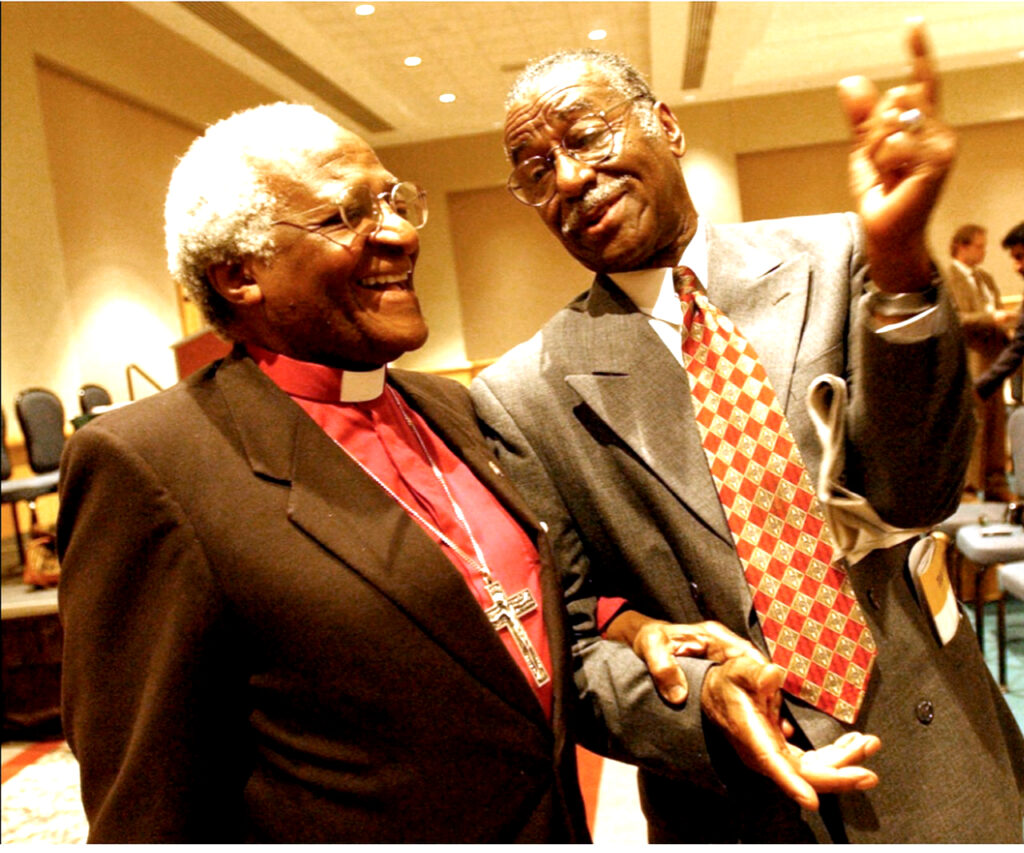
Archbishop Desmond Tutu, a pioneer of South Africa’s civil rights struggle, came to Alabama in 2002 and praised U.S. civil rights leaders for inspiring his fight against apartheid.
Tutu died Sunday in South Africa. He was 90.
Tutu came to Birmingham for the Transformative Justice conference, co-organized by the Birmingham Civil Rights Institute, where he joined Alabama-born civil rights leaders the Rev. Fred Shuttlesworth and the Rev. Joseph Lowery in a discussion of racial justice.
America’s civil rights pioneers inspired South Africa’s successful struggle to throw off the shackles of apartheid, Tutu said.
“We followed the exploits of all of your stalwarts,” Tutu said in Birmingham. “We were inspired by all of it. When the civil rights movement came, it was like something building up to a tremendous climax.
Shuttlesworth, then 80, embraced the 1984 Nobel Peace Prize winner after he met with reporters in a press conference. Shuttlesworth died in 2011. Shuttlesworth had led efforts to desegregate Birmingham in the late 1950s and early 1960s.
At the conference, Shuttlesworth had conversations with Tutu, a pioneer of South Africa’s civil rights struggle, and former South African President F.W. de Klerk, who announced initiatives in 1990 toward abolishing apartheid.
They were all speakers at the conference. Tutu won the Nobel Peace Prize in 1984 for his role in fighting South Africa’s segregation system called apartheid. De Klerk, who helped dismantle apartheid, shared the Nobel with his successor, Nelson Mandela, in 1993. The white-majority government led by F.W. de Klerk surrendered power in 1994. Mandela was elected president in 1994 in the first all-race elections in South Africa. Tutu served as chair of the South African Truth and Reconciliation Commission.
On their visit to Alabama, De Klerk and Tutu both connected South Africa’s history to Birmingham’s.
“How are you able to describe to anyone what it means to be free?” the 70-year-old Tutu told reporters before speaking at a luncheon to conclude the three-day Transforming Justice conference. Tutu, the retired head of the Anglican Church in Southern Africa, then spoke at Cathedral Church of the Advent in a noon worship service on his last day in Birmingham.
Tutu recalled reading about Jackie Robinson breaking the color barrier of Major League Baseball in 1947. “I didn’t know baseball from Ping-Pong,” Tutu said. But the story inspired South Africans who were suffering racial repression, he said. Tutu thanked Americans who supported the effort to end apartheid, South Africa’s state-sanctioned racial segregation that limited the rights of the black majority. “We want to express our very profound gratitude to all of those who have assisted us in achieving what we have achieved,” Tutu said. “Today Nelson Mandela can walk a free man. We can have a democratic society that is striving to be nonracial.”
Tutu was the Anglican bishop of Johannesburg from 1985-86 and archbishop of Cape Town from 1986-96, serving as the first Black African to hold those positions.
Tutu at the time of his Alabama visit encouraged U.S. investment in South Africa, a reversal from calls to divest that helped pressure the government to dismantle apartheid.
“We hope that our friends who listened to us when we said divest will now listen to us when we say invest,” Tutu said.
In 2002, Tutu said he had already seen dramatic changes in South Africa.
“It’s fantastic to look at schools today that were segregated just 10 years ago and to see children who were made to be enemies by government decree now playing together,” Tutu said.
In a speech at the Harbert Center in Birmingham, Tutu discussed his role overseeing the Truth and Reconciliation Commission, which heard testimony on the abuses of apartheid.
“The world saw an extraordinary display of magnanimity,” Tutu said. “People who by rights had been bristling with bitterness and anger and revenge, spoke of none, saying, ‘We forgive.”’
The process of forgiveness and reconciliation can be a model in the Middle East and elsewhere, he said. “South Africa is now a beacon of hope for all of the world’s conflict areas,” Tutu said.
