

Mike Ball reflects on faith, civil rights and why Alabama needs public servants who put conscience ahead of party loyalty.
by State Rep. Mike Ball, R-Madison, is a member of the Alabama House of Representatives
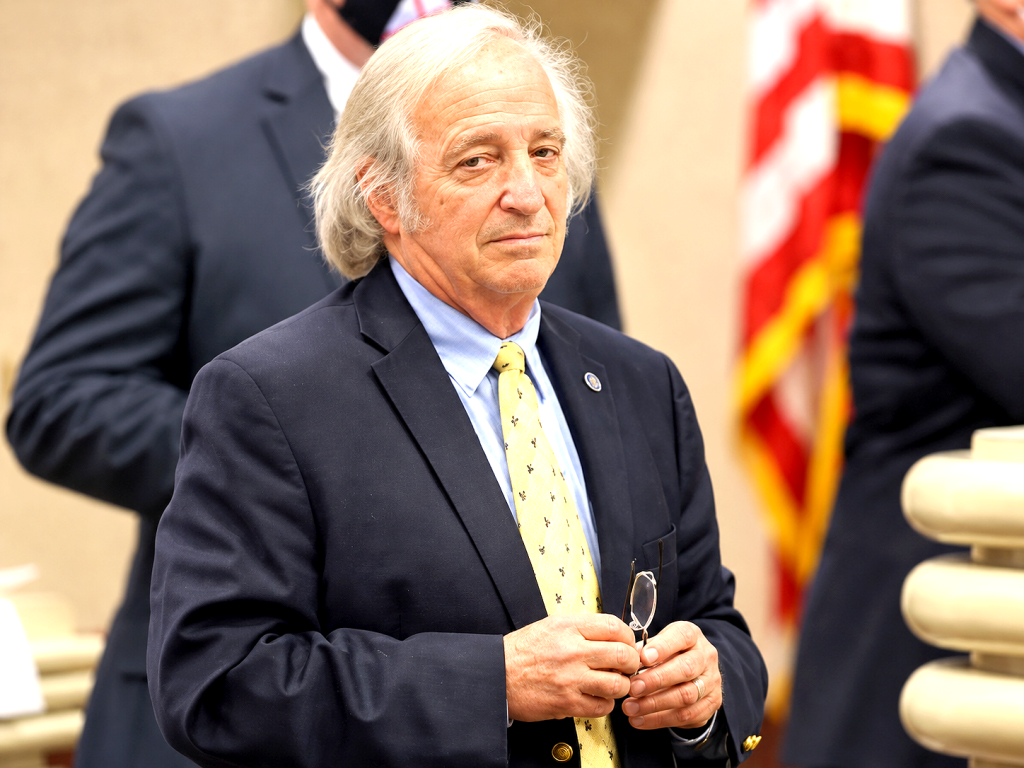
When Governor George Wallace administered the oath of office to the graduating trooper class of 1978, I became the littlest trooper in the history of the Alabama Department of Public Safety, thanks to a 1976 federal court ruling. A three-judge panel that included Judge Frank Johnson struck down the department’s height and weight requirements as unconstitutional. Those requirements disproportionately excluded women from employment. Johnson, a Republican from the Free State of Winston, had been appointed by President Dwight Eisenhower in 1955.
Although my hiring received no media attention, the civil rights movement had opened a door for me, too. Six years earlier, a federal court ruling had opened the department’s ranks to Alabama’s first Black state troopers. As a white male who directly benefited from the civil rights movement, I have often pondered why its universal application has not received greater emphasis.
One reason could be that, at some level, the movement was corrupted by partisan politics more focused on creating division than promoting unity. I would love to be wrong, but politics can corrupt anything it touches, even someone’s faith. That is especially troubling when your faith teaches that God is love. Politics divides. Love unites.
Upon graduation from the trooper academy, I was assigned to the Birmingham Post, working mostly the night shift, often as the lone trooper on duty in Jefferson, St. Clair, Shelby, Walker and Blount counties. Since state trooper radios were incompatible with those of most local agencies at the time, backup was often out of the question.
Regardless, I loved the freedom of the night shift, and every day was full of new adventures. It seems to me that high-speed pursuits and fights with police were more common then than now, but they were not as well publicized. At 5 feet 4 inches and 130 pounds, some of my colleagues had their doubts about me, but those doubts soon faded. Fresh out of the Marine Corps and mostly oblivious to both my size and my mortality, I was a living example of the adage that fools rush in where angels fear to tread.
Nearly half a century of battling giants has made me intimately aware of my mortality and my inherent weaknesses. But as that awareness has grown, so has my recognition that an unseen hand was always near, even when I felt alone. Especially when I felt alone, because those were the times when I was sufficiently humbled to realize how much I needed its help. The God I worship draws near to those who suffer and away from those who inflict suffering, without regard to political or religious labels.
In June 1979, I was part of a large contingent of troopers sent to Decatur in response to escalating protests and counterprotests. The unrest had festered over the previous year amid the questionable case against Tommy Lee Hines, an intellectually disabled Black man whose intellectual functioning several experts assessed at the level of a 6-year-old. He had been charged with rape.
A shootout had occurred on the streets of Decatur the previous month amid those protests. On July 26, 1979, Alabama enacted a law prohibiting firearms at public demonstrations, with an exception for law enforcement officers on duty policing the demonstration.
My fellow troopers and I stood abreast in full riot gear in a single line in the middle of Lee Street, alternately facing the protesters on one side and the Klansmen on the other. I was facing the Klansmen, but ugly taunts and slurs traveled back and forth in both directions. A thick layer of hatred polluted the atmosphere.
Standing there, I felt outside myself as I began to pray, hungry for discernment. While I prayed, an overwhelming thought entered my mind that has remained with me ever since, helping shape both my faith and my understanding of politics: “They need each other.”
I am not saying the two sides were equal. They certainly were not. But it was obvious to me that extremists on both sides were feeding the flames of hatred that filled the air. There is something in our self-centered, self-righteous, prideful human nature that, if not controlled, causes us to mimic the evil we resist.
The Christ I envision teaches another way to resist evil, one that is counterintuitive to traditional adversarial politics. It is fueled by faith, not fear. It is abhorrent to those consumed by the political idolatry that drives zealotry. Many others throughout history, including Martin Luther King Jr., have followed it. This way has often been endangered, but never extinguished. It is not a path for the faint of heart, because it invariably attracts persecution from the powerful and proud. It is the path Jesus walked and beckons others to follow.
Make no mistake: Self-righteous zealots exist within the ranks of both major parties, driven by a lust for power. But both parties also have sensible moderates who seek to serve rather than rule. That creates intraparty tension that comes to light mostly during primary season. Unfortunately, absurdly low primary turnout favors the more extreme elements, since civic-minded centrists and independent voters who tend to temper those extremes are more likely to participate only in general elections.
I was an active Republican for many years and did what I could to support the ALGOP. But about a decade ago, the party began to turn in one direction while my conscience led me in another, causing me to lose my taste for partisan politics. Now that I am no longer bound to a party, however, my political interest seems to have been rekindled.
When I heard about Doug Jones’ recent campaign event at the Von Braun Center in Huntsville, it occurred to me that I was 72 years old and had never attended a Democratic political rally. Curiosity drove me to check it out for myself. It turned out to be very different from what I expected, given that much of what I had heard about such events came from the other side.
Granted, there may have been a few sneaky communists there. But if so, they were cleverly disguised, because nothing I saw or heard gave me any indication of their presence. And I didn’t hear a single cringeworthy remark that contradicted my Christian faith, except when they played a montage of Senator Tommy Tuberville’s absurd quips on the video screen.
The place was full of friendly people who looked and acted just like the folks around me every day. Jones gave a positive, uplifting message of hope for Alabama. There was a general feeling of optimism in the room, despite the fact that most of their candidates are long shots. Having been an underdog most of my life, I am sympathetic to their plight.
Although I am not a Democrat and have no interest in partisan affiliation, I agree with those who believe the ALGOP has grown too big for its britches over the past decade. I believe it’s past time for voters to send the party a message and give it some comeuppance.
I’m not expecting a drubbing like the Democrats received in 2010 after dominating Alabama politics since Reconstruction. Part of me doesn’t expect much of anything. I know how difficult it is to challenge an entrenched power structure.
I just think Alabama’s political climate would benefit from a minority party or an independent movement strong enough to challenge the majority when it tries to go too far, too fast. We used to call that conservatism, and it is one of the main reasons I’m about to vote for a number of Democrats in this general election.
Even so, I’m still voting for more Republicans than Democrats. Of the 30 races on my sample ballot, it looks like I’ll probably vote for 12 Democrats and 18 Republicans.
For me, it’s about voting for those I believe are most likely to promote moderate, common-sense governance, grounded in the idea that true greatness is achieved by those who humble themselves and serve others. Jesus demonstrated that when he washed his disciples’ feet, including those of the one he knew would betray him. We need public servants in public office who recognize that we desperately need less fighting and more foot washing.
There is a season for everything, including partisanship, and we are at the peak of that season. But the November 3 general election will soon pass, and the season will be over for many.
For others, it never ends. Some people have become so consumed by politics that it has become their guiding light. But it is a light that needs an off switch, because it ultimately leads to corruption and darkness.
We need to elect leaders who follow an entirely different sort of light—the one that leads toward truth and justice.