

By Roy S. Johnson

Do no harm. First, do no harm.
It’s a simple principle that should guide us all. Guide our actions. Guide our decisions. Guide our leaders.
Guide our businesses.
First, do no harm.
Nebius is the AI “cloud” company based in the Netherlands that’s spending upwards of $36 billion to construct two data centers in Birmingham’s bucolic Oxmoor Valley neighborhood. The centers will span a gargantuan 450,000 square feet on 75 sprawling acres.
A vocal and tenacious bunch of folks who live or work in the area aren’t at all happy about it. Not a single bit. Some of their fury, let’s be real, is NIMBY-fueled rage: How dare they build something in our neighborhood without our blessing?!
Some of it’s simple fear of the unknown.
Of higher utility bills due to the center’s gluttonous use of water and power. Of noise.
Fear of harm, which is a very reasonable fear — one stoking data center outrage nationwide, and binding unlikely, strange bedfellow alliances against them.
About 10 days ago, Birmingham Mayor Randall Woodfin stoked the fear by calling Nebius out on a radio call-in show. Sitting in on V94.9’s “Think Tank” for recuperating host Chris Coleman, Woodfin said: “Nebius needs to open their mouth and communicate to residents that they’re not going to cause harm to the community because people believe it’s going to cause harm to the community…and those are facts.”
I called the folks at Nebius and challenged them to, well, open their mouth. Somewhat surprisingly, they did.
“The mayor’s right,” said John Sutter, vice president of public affairs and the U.S. “mouth” for Nebius’s operations. “We need to open our mouth. He makes a really good point when it comes to the way people are feeling around the Oxmoor Valley and around Birmingham right now.
“This site is designed responsibly and will be built and operated in a responsible manner,” he continued. “We need to do a better job of demonstrating why that’s the case.”
Locally, Nebius’s “mouth” is Leah Davis, the Alabama public affairs officer. She’s a native Mississippian familiar to many in Birmingham because she’s worked here for years with United Way, Red Mountain Park and Jefferson County Greenway.
“We want people to know that we hear them,” she told me. “I live here in Birmingham. I’m on social media, doom-scrolling, for better or worse. So, we see what people are saying. We’ve made a decision that we want to be more upfront and even more transparent than we have been, so that people really know who we are and that we intend to cause no harm.”
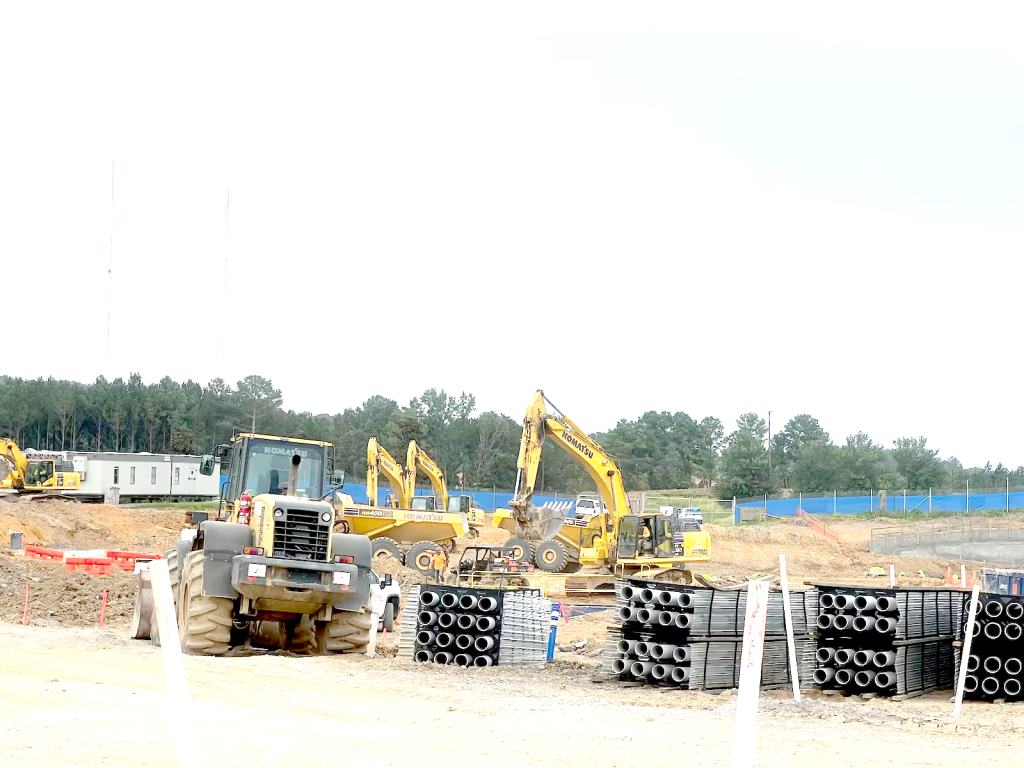
I was escorted onto the sprawling dust cloud building site last week. It’s hugged by statuesque tree lines on two sides and by major roadways on the others. Three lawsuits have been filed in an effort to halt construction, at least temporarily. Yet, for now, the acres are abuzz with machinery, concrete, iron and myriad men and women under the direction of Birmingham-based Hoar Construction.
“We expect about 1,000 construction workers on site at peak construction,” Sutter said. “The majority of those workers are from the Birmingham metropolitan area.”
A summer thunder roll paused construction for several minutes as I arrived. Before long, though, the familiar whirring and beeping sounds of construction resumed and dozens of yellow-vested workers in white hard hats returned to their positions.
The angry, marching and litigious voices have some valid concerns. They believe to their core that Nebius will inflict harm on their pastoral lives. Whether founded or not, their fears deserve to be squarely addressed.
Sutter on water fears: “This is a closed-loop system, which means we recycle water through the system. We’re charged once, and that’s it. The rest of the water used in the building is what you’d have in a typical office building.”
On power fears: “We have a contract with Alabama Power. They’ve said they have the capacity to serve us, and we pay our full cost of power to ensure there’s no impact on ratepayers.”
On noise fears: “That’s a really big one. We’re intentional about understanding our site: What is the noise-making equipment, and how can we enclose that to keep that sound contained to the site?”
Data center noise, Sutter said, is created by dry coolers, chillers and generators. Addressing the latter first, he said there will be four generators enclosed by “acoustical sound walls,” and they’ll “only kick in if there is a power outage. They are for backup use only, so they’ll run an hour a month for testing, and if we lose power to the site, they’d be used only for safety lighting and an emergency shutdown of the facility.”
Added Davis: “We do not have to be a 24/7 facility, so if there’s an outage, the generators will just kick on to power the facility until operations power is restored.”
Think of data center dry coolers akin to those muscular HVAC systems atop every commercial building — but on steroids. Chillers are also heavy-duty machines that supply cold water to counter heat generated by the Kong-like servers that wield AI’s power.
“The dry coolers and chillers are also enclosed by sound walls,” Sutter said. “These are acoustical sound walls that absorb sound waves. We have sound canopies over them as well. Then we also use ultra-low, quiet fans, which dampen that noise and bring sound levels down even further. So, these are all intentional design decisions made to limit any potential impact on the community around us.”
Some fears and some rage will, of course, never wholly subside because data centers have become our Frankenstein — the scary monster in our midst.
Moreover, we just won’t know if Nebius’s promises are fulfilled until it flips the switch and the monstrous hyperscale AI facility is powered up. And unleashed.
Even then, we won’t fully know. Sure, the folks living beyond the surrounding trees and roadways will know soon enough if their ear-fears were founded or flawed. Yet it may be months or even years until we know if data centers do any harm.
Or if they’re the economic oasis supporters purport them to be, and local officials pray they will be to justify the $3.2 billion in incentives approved for Nebius over a 30-year period.
Until then, Sutter and Jones said Nebius will continue to open its mouth. And hear.
“We’re willing to sit down and meet with anybody,” Davis said. “We’re willing to answer the tough questions and to be more transparent.”
Mainly, folks, just do no harm.