


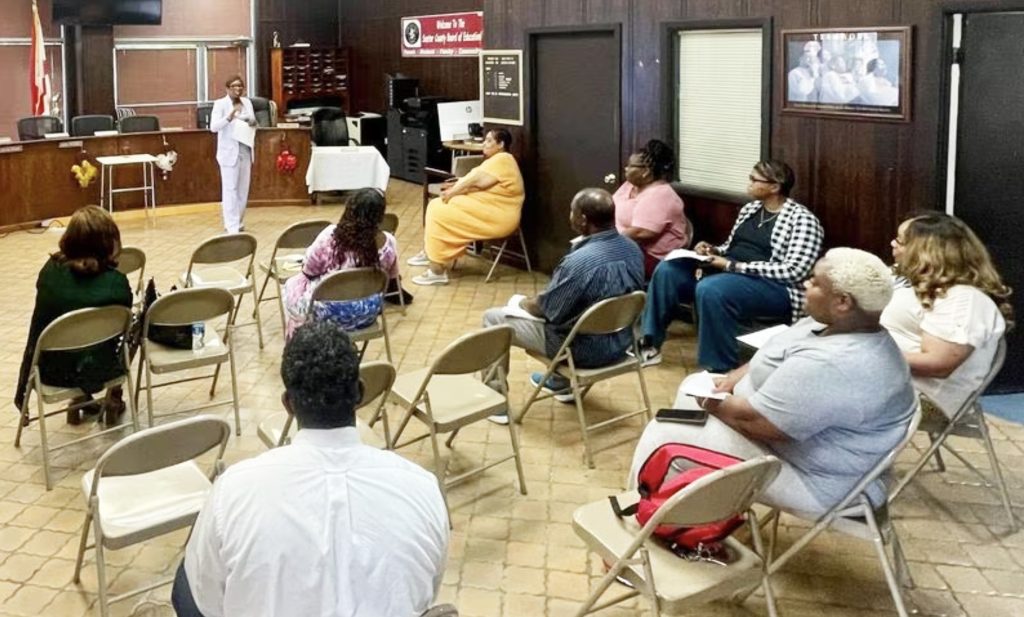
Two months into state intervention, staff at Sumter County Schools have been hard at work: The books have been balanced, the football field spruced up, and officials have a detailed plan to improve student test scores.
But educators have a lot of work to do before the district, which is one of the state’s poorest, can get back on track.
“I don’t have a problem with meeting students where they are,” Superintendent Marcy Burroughs said to a packed board room of community members Tuesday night. “I have a problem with when we meet them where they are, they stay there.”
At the start of the year, just 2% of students district wide have mastered grade-level math skills, and 8% are reading on grade level, according to data shared at a board meeting this week.
At Livingston Junior High School, the largest of the county’s four schools, every single fifth grader is at least two years behind in math.
As students get older, they’re lagging further behind because they don’t have the foundational skills to do well, Burroughs said as she flipped through the numbers.
“Should this surprise you?” she asked the crowd.
“No,” they chimed back.
“So what this means is we’re going to have to work harder to build up our students,” Burroughs said.

Sumter County schools have struggled for years with declining enrollment, outdated facilities and poor student test scores. The district’s inability to complete a required yearly audit of their finances forced a state takeover in August, officials said.
Burroughs, a former school improvement specialist, took the job as the district’s superintendent this summer. In her first few weeks in office, she’s taken a hard look at student achievement, and has shared those results with community members.
Her plan, she said, is going to involve individual support for students, high-quality coaching for teachers and administrators, and more resources toward school safety and security.
Currently, 937 students are enrolled in the district’s traditional public schools – a 45% decline from ten years ago. Several families, and some teachers, have left to attend a new charter school in the county, but that’s not where all the bleeding has been, officials have said.
“We have to change the culture and the climate of our district, because we want to do what?” Burroughs asked the room. “We want to have teachers stay, we want students to stay, and we want to attract students back to the district.”
Over the years, many community members have grown frustrated with the local board, and have worried that politics were getting in the way of progress.
Just days before school was set to start this year, two board members voted not to hold a meeting – forcing the district to delay the start of classes because they couldn’t hire teachers and fund necessary programs. One of those members, Beretha Washington, suddenly resigned this fall, AL.com has learned.
Now, halfway into the first semester, more and more residents are turning out to meetings to hear how the district plans to turn itself around.
“I’m feeling very uplifted because we have new leadership, and she is engaging people to do better and improve the system,” said Lucius Black Jr. of Sumter County Concerned Citizens, a group that’s been pushing for improvement in the local schools. “I think we’re on the right path.”
“Our children are struggling, and they’re struggling partly because of the pandemic, but partly because there has not been an emphasis on academics as much as there is now,” he added. “I think there may have been some problems that they overlooked and that they missed, but now she’s focused in on those problems and trying to make sure that the children improve their lot.”
‘Pain points’
When the state intervenes in a school district, that means the local board of education is no longer in charge of decisions about personnel, finance or operations.
But state leaders say they’re confident in Burrough’s abilities, and are hoping to work in tandem with the district on big decisions.
“I think it can be done, but I think there’s gonna still be some pain points,” State Superintendent Eric Mackey told AL.com last week. “And part of that is going to be right–sizing facilities.”
Kenneth Wong, a professor of education policy at Brown University who has researched school takeovers, said it usually takes about two or three years to see any academic improvement in districts under intervention.
During the first year of a takeover, it’s important to build up stability in finances and facilities, he said, so that schools can fully support classroom learning. And it’s imperative to be transparent about those changes from the onset.