

SOURCE: BlackChristiannews.com
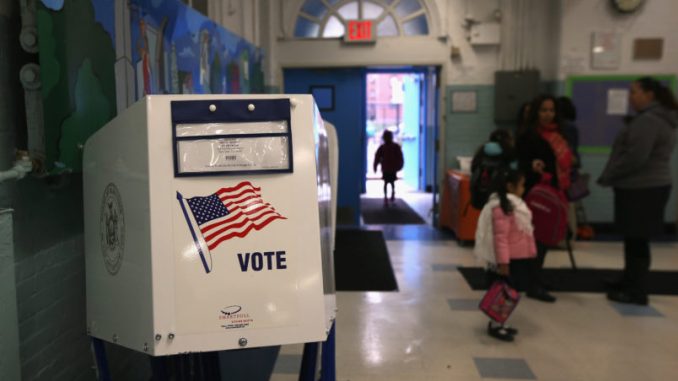
With the midterm elections less than a month away, a strong majority of Americans are concerned the nation’s voting systems might be vulnerable to hackers, according to a poll released Wednesday.
That is roughly unchanged from concerns about election security held by Americans just before the 2016 presidential election, but with a twist. Two years ago, it was Republicans who were more concerned about the integrity of the election. This year, it’s Democrats.
The survey from The University of Chicago Harris School of Public Policy and The Associated Press-NORC Center for Public Affairs Research found that Democrats have grown increasingly concerned about election security while Republicans have grown more confident.
By 58 percent to 39 percent, Democrats are more likely than Republicans to say they are very concerned about hackers affecting U.S. election systems. That represents a flip from the results of a similar survey taken in 2016.
The same partisan divide exists in the confidence Americans hold in the accuracy of vote tallies for the upcoming midterm elections. Republicans are more confident, a reversal from 2016.
Nearly 8 in 10 Americans are at least somewhat concerned about potential hacking, with 45 percent saying they are extremely or very concerned. Just 22 percent have little or no confidence that votes will be counted accurately. Those results are similar to a poll conducted in September 2016.
Nearly 80 percent of Americans say they are at least somewhat concerned about the hacking of voter registration systems, voting equipment and final election results, with at least 4 in 10 saying they are extremely or very concerned about each.
Among the biggest concerns of cyber-security experts is the use, in some states, of touchscreen voting machines that do not produce a paper record.
A U.S. Senate report earlier this year urged states to replace their paperless machines, which were used by roughly one of every five voting jurisdictions nationwide in the 2016 election. Five states — Delaware, Georgia, Louisiana, New Jersey, and South Carolina — are expected to rely on electronic machines without paper receipts during the upcoming midterm elections. At least eight others will use those machines in some counties.
The $380 million sent to states from the federal government was not enough to cover the costs of replacing all
such machines.
Jennifer Blomqvist, a 47-year-old administrative assistant from Decatur, Georgia, said she is concerned voting systems remain vulnerable to hackers and would support a system in Georgia that produced a paper record.
The survey also found limited support for online voting (28 percent in favor) and for the exclusive use of mail-in ballots (19 percent in favor). Younger voters, those age 18 to 29, are more supportive of online voting than older adults. Even so, less than half of young adults favored online voting.
Three states — Colorado, Oregon and Washington — conduct all elections with mail-in ballots, but there is not widespread support for it. Just 19 percent of adults favor such a system with 58 percent opposed.